
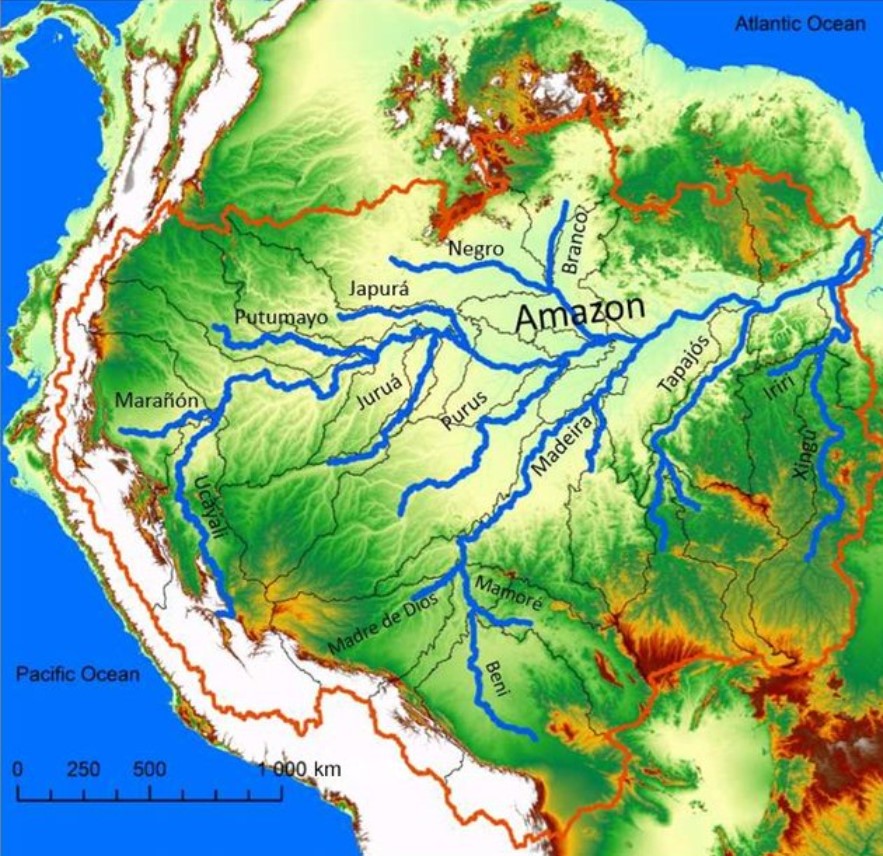
In late August and early September we journeyed with our friends Peg and Roger to South America. This was an “Expedition, not a Tour” organized by Lindblad Expeditions and National Geographic to the Upper Amazon region of Peru. We explored two of the major tributaries of the Amazon, the Ucayali and the Maranon, which arise in the Andes Mountains of Peru and come together at Nauta, Peru to form the Amazon. The Amazon proceeds from there for another 3000 miles through parts of Peru, Columbia and Brazil before emptying into the Atlantic. It delivers 30% of all of the fresh water in the world. It is considered the longest river on the planet at 4345 miles in length, allegedly longer than the Nile by 87 miles (but other trips to Egypt found folks there who disputed that).
August 31, 2024: LIMA, Peru
We began the expedition in Lima, Peru, where we visited Plaza de Armas and surroundings in the heart of colonial Lima. In 1988, UNESCO declared the historic center of Lima a World Heritage site for its high concentration of historic buildings constructed during the Spanish colonial era. Ornate facades line centuries-old streets, adorned with more than 1600 intricate balconies, plus palaces and cathedrals begun in 1535 under Francisco Pizarro.
We stayed at the Country Club Hotel in fashionable San Isidro and visited Huaca Pucllana, an adobe pyramid built by the pre-Inca Lima Culture in 200-700 AD and now one of several pyramids surrounded by the city of Lima.

September 1, 2024: LIMA to Iquitos to Nauta
The next day we flew 1.5 hours over the Andes Mountains from Lima to Iquitos, Peru, a city of 500,000 that is only accessible by air or river. Only one road leads out of the city, going about 50 miles to Nauta where we boarded our ship, the Delfin II. Iquitos was the center of the Peruvian “rubber rush” in the late 19th Century and early 20th Century when rich rubber-barons built lavish mansions, opera houses, etc. in the grand European style.


 John and Paula's Blog