Indonesia and New Zealand 2025

In November 2025 we travelled to Denpasar on the Indonesian island of Bali for work, coordinating a Conference attended by power plant Owners and Operators from 23 countries. While we were in the neighborhood we decided to visit New Zealand on the way home, which had been on our “interesting” list for some time. When we got to New Zealand, the NewZealanders (called Kiwis) explained that we had it severely backwards. One was supposed to do work in New Zealand and party in Bali.

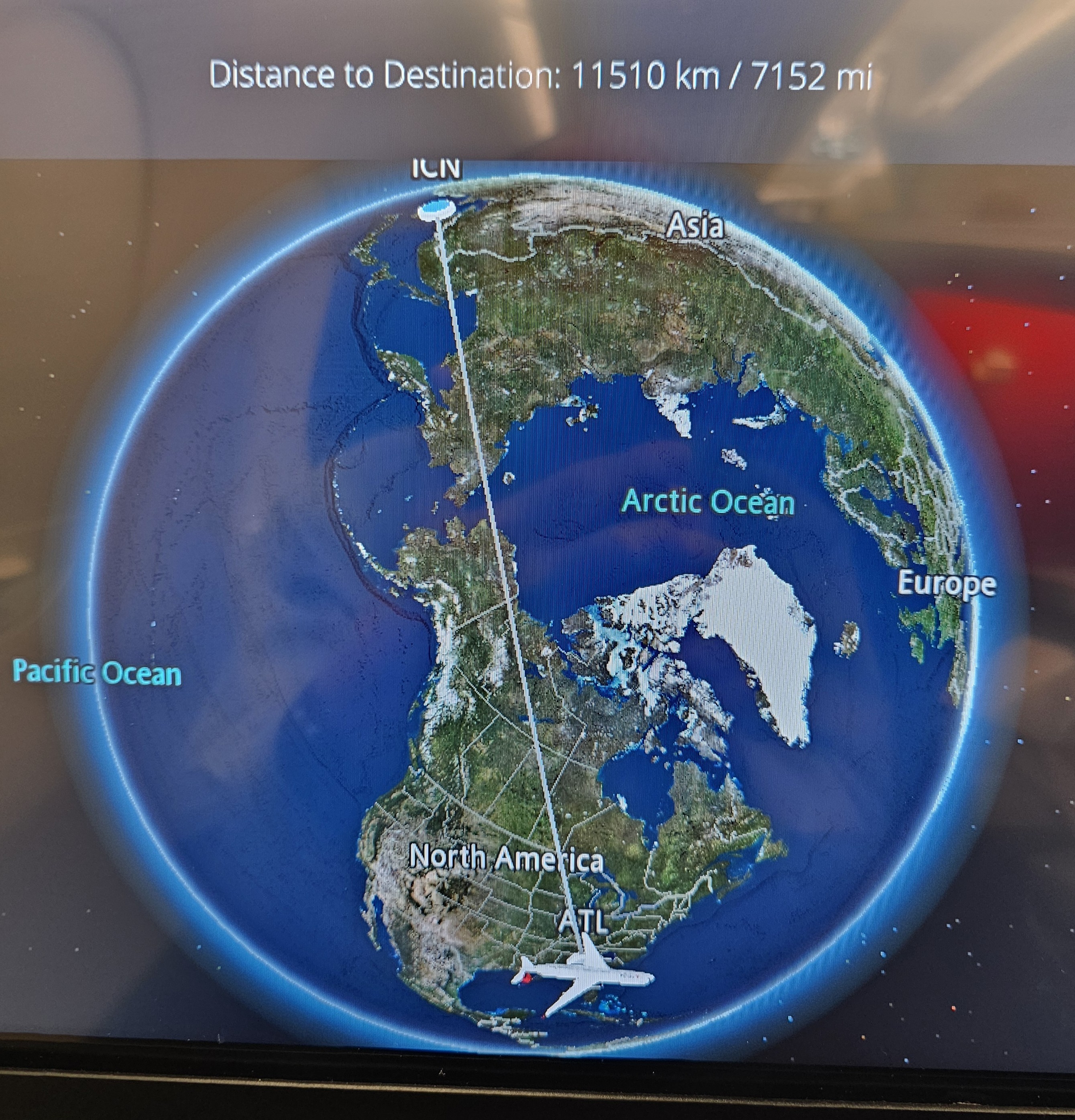
To get to Indonesia we took a 16 hour flight from Atlanta to Seoul, South Korea going 7152 miles over Alaska, the Arctic Ocean and almost over the North Pole.  That got us close to Indonesia.  It only took another 8 hour flight south to get there. It was a bit over 11,000 miles door to door.
When we got there, two days later and after 36 hours of travel, we celebrated at our hotel. Then we got down to work, with a strategy meeting with the Users’ Group Chairman at the beach bar with the Indian Ocean in the background, followed by several days of meetings.
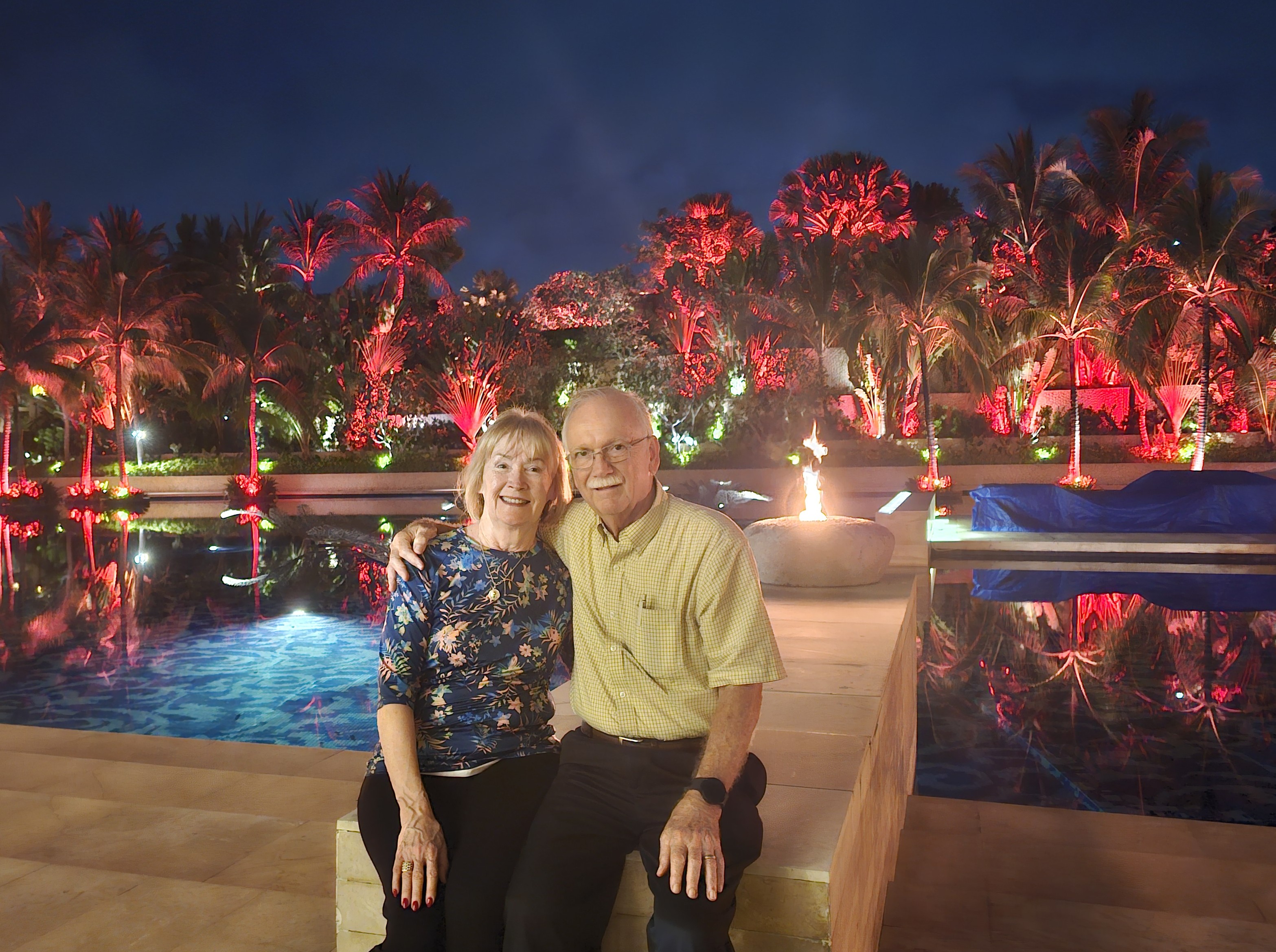
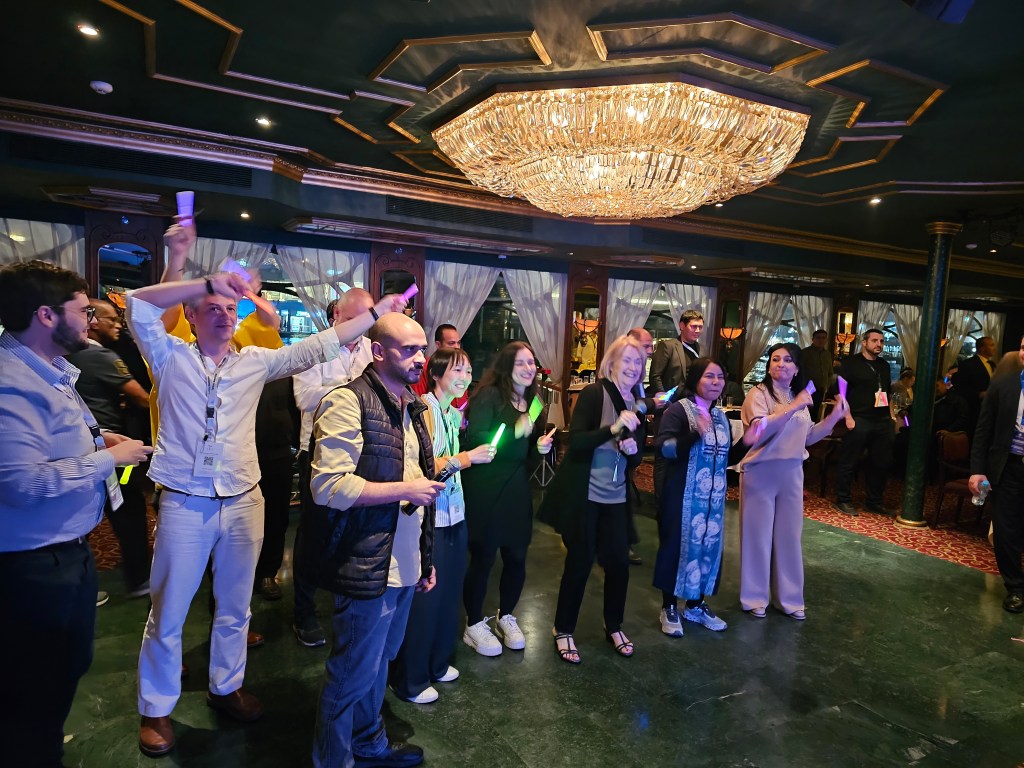
The Conference was not all work, however. The world-famous Dancing Queens performed once again

After the Conference we flew to New Zealand for the second phase of our Indonesia/New Zealand expedition — the fun phase.  We had decided to visit New Zealand since we were already “in the neighborhood” in Indonesia.  Turns out the neighborhood was an 8 hour plane ride and 5 time zones away across the middle of Australia!

We landed in Auckland, New Zealand on the North Island.  Auckland is known as the “City of Sails” and is the current home of the Americas Cup for sailboat racing.  New Zealand has won the last three “Americas” Cup competitions (2017, 2021 and 2024).  We went out onto the sailing course in the Auckland Harbor in a retired Americas Cup boat.

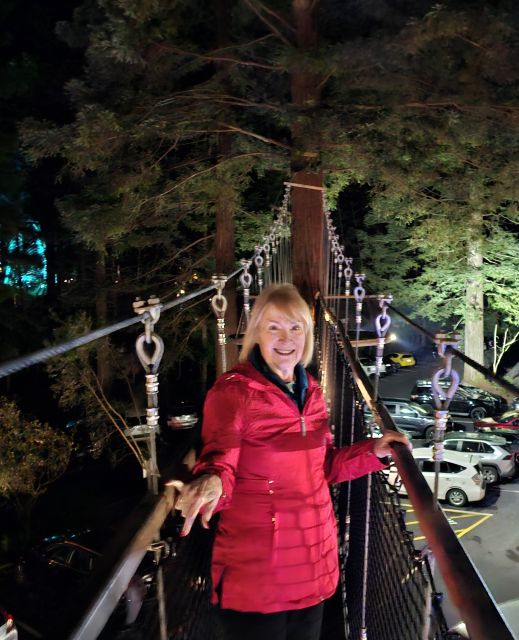
John got to drive it as well.   It is 80 feet long with a 120 foot mast which carries over 600 square meters of sail.  The wind was light, but it got up to 7 knots of speed with all that sail area.  Later in the day we hiked to a series of fresh water springs that were sacred to the indigenous Maori people and moved to Rotorua for the next two nights. Once in Rotorua, we went on a lighted night walk after dinner, high in the trees in a grove of 75 meter high Sequoia (redwood) trees on a series of 28 suspended bridges and 27 platforms that got up to 20 meters off the ground.  Fortunately, it was too dark to see clearly how far away the ground was.
The next day was focused on Maori culture, with a visit to a traditional marae (meeting place) in the Maori village of Marupara, ancient rock carvings carbon-dated to 1050 AD and presentations by Maori guides on their culture, ancestors and current social status. Later in the day we visited the Waiotapu Geothermal Park to hike around a series of geysers, boiling mud pots and other volcanic features.

After three exciting days on the North Island of New Zealand we flew from Rotorua to Christchurch on the South Island.  We were driven from there to the “New Zealand Alps” area, stopping on the way at Lake Tekapo to photograph the most photographed church in New Zealand.

We stayed the next two nights near Aoraki/Mt. Cook which is the highest mountain in New Zealand at over 3700 meters (12,200 feet).  The area has 19 peaks over 3000 meters.  Here is the view from our hotel room, with Aoraki/Mt. Cook in the distance in the center.

The next day we took a glacier boat cruise on Lake Tasman to the foot of the Tasman Glacier, stopping on the way to learn about and examine the icebergs which had “calved” from the glacier in the previous days and were floating about in the lake.  Their crystal-clear ice was estimated to be 500-600 years old.

That afternoon we logged over 20,000 steps hiking in the foothills of the Aoraki/Mt. Cook National Park with Leon and Julian (imagine that)!  Julian was our tour director and Leon was the park’s guide for our hike.

We topped off the day with a Dark Skies Star Show in the hotel’s planetarium.  The day had been generally overcast to that point, but when we exited the planetarium at 9PM it had cleared up and we were treated with a fleeting few minutes of beautiful “alpine glow” as the sun set over the mountains.

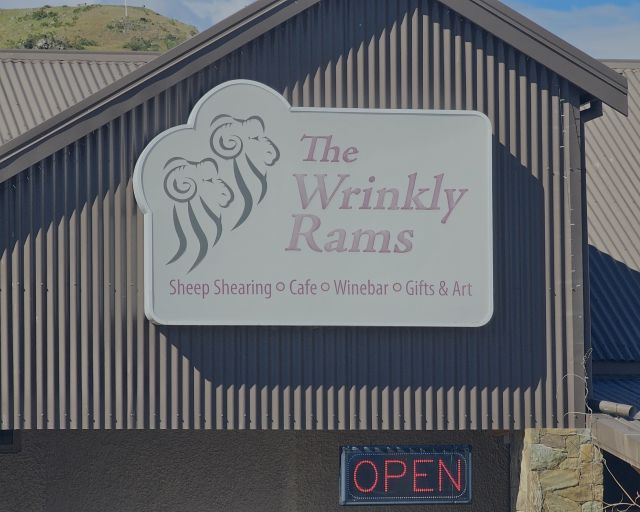
After leaving the mountains, we headed to Queenstown – the adventure capital of New Zealand.  Lots of outdoors-types come there to ski, hike, paraglide, rock climb, etc. On the way, we stopped for coffee at the Wrinkly Rams outpost.  Note the additional service provided is “sheep shearing” in addition to coffee.  The low population density in the South Island results in some interesting combinations.
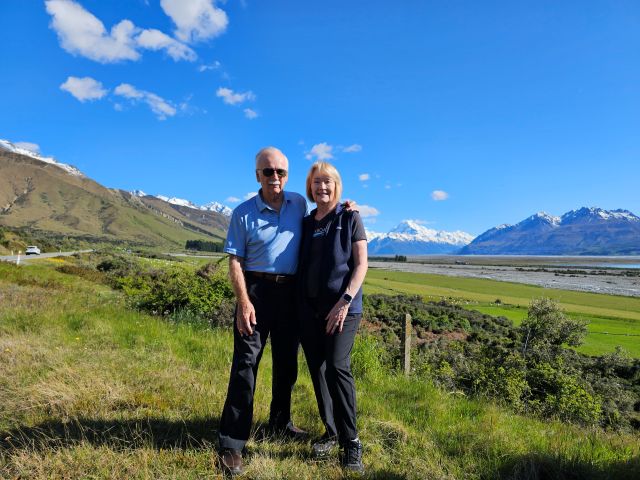
We stopped for lunch in Arrowtown, an old gold mining town dating from the 1860’s that reminded us of Silverthorne in Colorado, which has a similar history and is about the same vintage.  It seems that for some reason the gold rushes happened all at about the same time in the US, Australia and New Zealand.  And that was before the power of social media caused excessive focus on a topic!

We had a “small world” moment in Arrowtown.  We stopped for lunch at the Fork & Tap for lunch, where the bartender asked us where we were from.  When we said Florida he asked where in Florida.  When we said New Smyrna Beach he was incredulous.  He was born in Bert Fish Memorial Hospital in NSB and grew up in Flagler Beach!

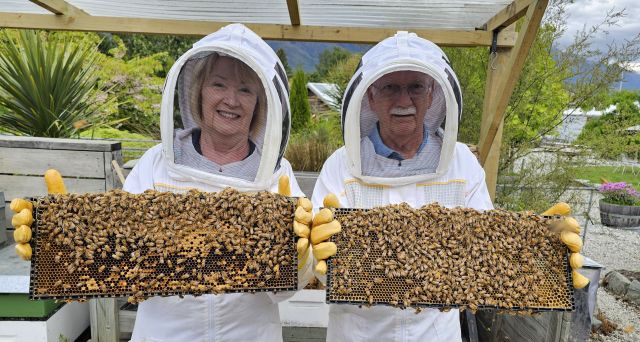
Once in the Queenstown we stopped at the Buzzstop Honey Center, run by a local beekeeper.  Seems that the world’s best and most expensive honey comes from New Zealand because of the Manuka flowers (at least that’s what he claimed).  There we “met the bees” and learned all about bees and harvested our own honey.  That whole story was amazing.
Arriving in Queenstown, we checked into our hotel room, which had an amazing view of Lake Wakatipu and the South Island mountains.

The next morning we took the “steepest gondola in the Southern Hemisphere” to the top of Ben Lomond.  Seems this town was settled by Scottish people in the mid-1800’s, so they have “Bens” instead of mountains.  The view of Queenstown was spectacular, even though it was raining a bit.  Interestingly, Queenstown is the largest city on the south end of the South Island, with 29,000 inhabitants and a metropolitan area of about 50,000 population.  About the same size of Winter Springs or New Smyrna Beach, but it seemed much larger.

After going up in the gondola, we hiked down, thinking gravity would be a good help.  Turns out it was very steep and rocky, but we survived.  We told our trip leader that we thought we were at the top end of the age range  that he should take on that trail in the future.  He seemed to agree, but he did mention that the last time he was on that trail he had run up it with his child on his back!

On our final “structured” day in Queenstown we were driven by our tour director to Glenorchy at the foot of Lake Wakatipu.  This is another small town focused on “adrenaline-filled adventure tourism”.  There we took a jet boat about 45 km up the Dart River Valley into Mount Aspiring National Park.  That river is only a few inches deep in spots as it meanders through the glacier-formed gravel going upriver.  At the top end of the river are sites where many movies were filmed to capture “quintessential, untouched New Zealand scenery” in Lord of the Rings, Chronicles of Narnia, The Hobbit Trilogy, Mission Impossible and other films.  Our jet boat driver was a bit of a “hot-dog” and treated us to five gut-wrenching 360 degree spins during the voyage.

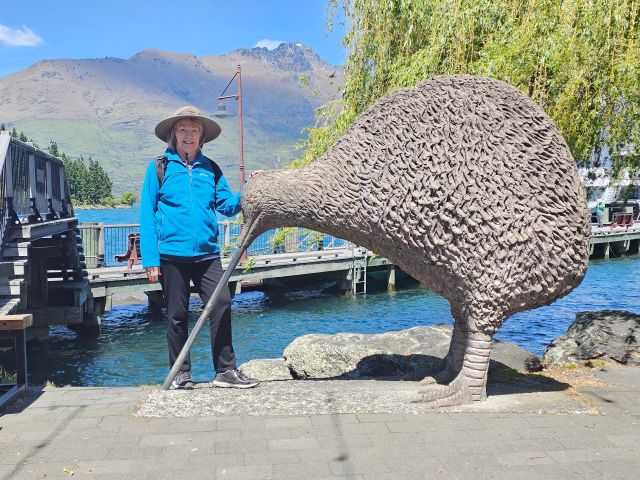
On our final day in Queenstown we relaxed a bit, hiked around the lakeshore and responded to E-Mails.  We had lunch at “Ferg’s”, home of the world-famous Fergburger, which CNN has proclaimed as the “best burger joint in New Zealand and perhaps on the Planet”.  As apparently is always the case Ferg’s was packed with long lines of foreign tourists, but Ferg’s Bar next door was almost empty and had the same menu, so we got our Fergburger.  On the way back to our hotel Paula posed with a Kiwi, the flightless bird that is the best-known national symbol of New Zealand.

We got home safely and eventually recovered from jet-lag.  It was another 36 hour journey, this time over the very empty southern Pacific Ocean.

New Zealand was a great place to visit.  It may be too far away for us to visit again, but we highly recommend it if you are “in the neighborhood”.
Quebec and Charlevoix in Canada 2025

In August we went on a hiking expedition to Quebec, Canada with Peg and Roger.  We arrived safely in Quebec City on August 16 after several days of anxiety related to the Air Canada strike/shutdown situation that was the big news at the time.  Our alternate transportation was on United via Newark.  Fortunately, no air traffic system problems getting through there, as Newark had also become famous for its air traffic control equipment failures in 2025.

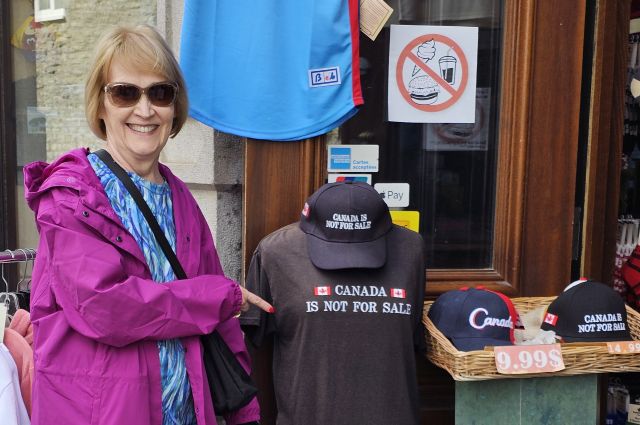
Our first day in Quebec City before meeting up with our hiking group was great.  The center of Quebec City is very walkable and picturesque.  We did some due diligence on the MAGA USA’s proposed 2025 acquisition and, while everyone was very friendly, it was clear to us that there were going to be some obstacles.

We were also adapting to the different weather in those northern latitudes.

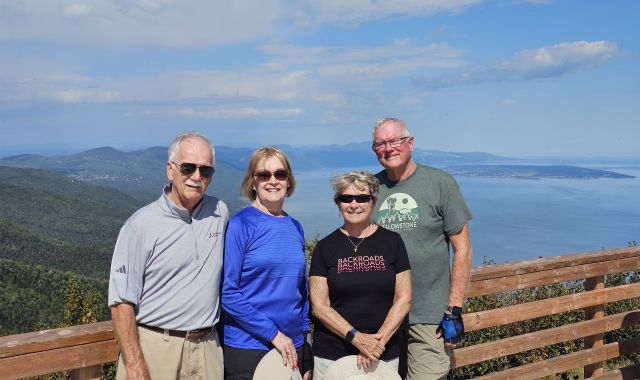
The next day we joined our Backroads hiking group of 15 hikers and three expedition leaders at La Gare du Palais train station in Quebec City.  We then drove north along the north shore of the St Lawrence River  to the Charlevoix region.  That region is a crater 54 km in diameter formed 400 million years ago when an asteroid 4.5 km in diameter struck earth at 20 km/sec.  The energy released during the impact was said to equal hundreds of millions of nuclear bombs.  The first day we did a 3.8 mile hike at Baie-Saint-Paul 1400 feet down the side of the crater, followed by a picnic and historical/horticultural lecture at a lavender farm.

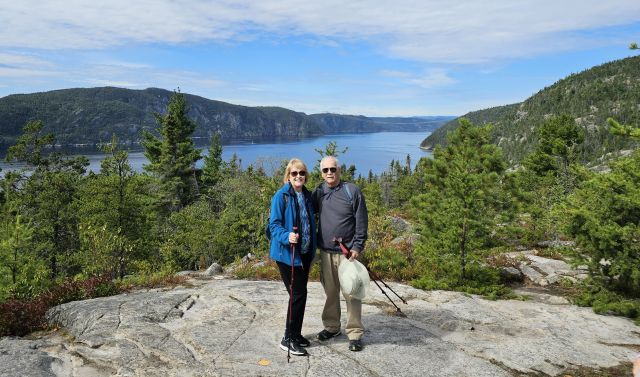
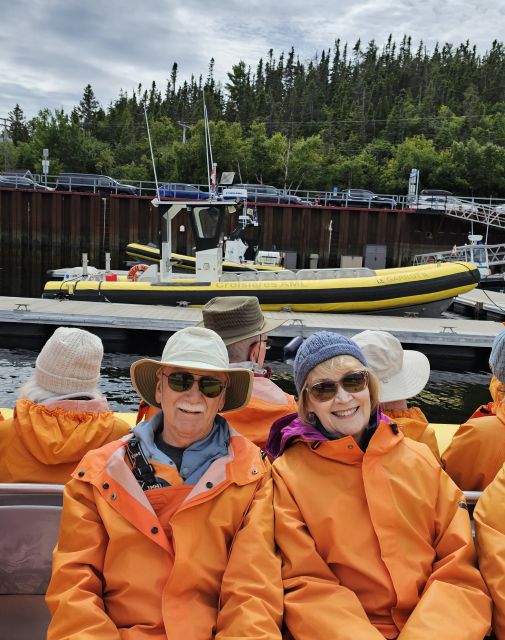
That afternoon we arrived at our home for two nights at the historic Fairmont Manoir Richelieu in La Malbaie.  On Tuesday we shuttled to Tadoussac, as far north as one can get before the end of the road on the north side of the St. Lawrence.  At Tadoussac we hiked 6 km on the Colline de l’Anse a la Barque trail, which our leaders described as “a bit technical” due to the route over many tree routes and large boulders.  They were right. It was a challenging but beautiful hike to the top of a hill and back down.  In the afternoon we donned orange wet suits for whale watching in the St. Lawrence from a zodiac.  We saw some, too.

For the next several days we did morning and afternoon hikes through beautiful territory, most with a fair amount of elevation gain to great viewpoints.  The knees and other pieces and parts were aching but remained generally functional.

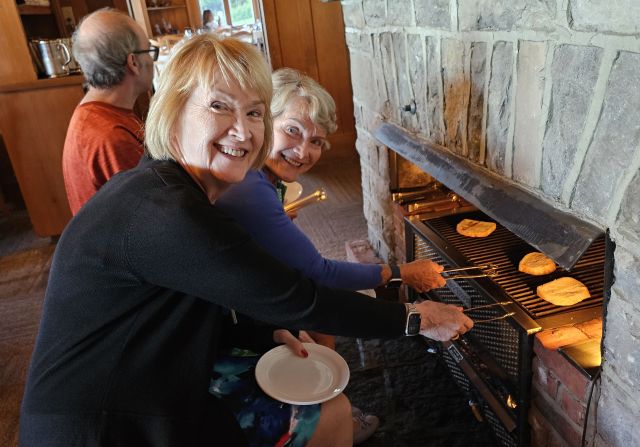
We had lots of food and snacks.  Our guide for the Quebec history tour the last day confirmed that the primary ingredient of Quebec food is calories, better to make it through the cold winters.  That, combined with the nickname “SnackRoads” given to our outfitter BackRoads, guaranteed that we did not lose weight that week.  We were also introduced to a couple of new dishes that are uniquely Québecois, including “poutine” (which is a preparation of french fries, cheese curds and savory gravy), lots of dishes that included maple syrup and the opportunity to toast our own bread for dinner.

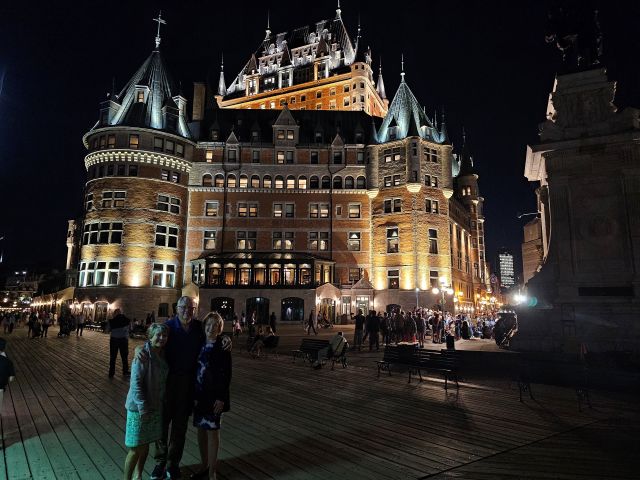
The final day we stayed in the historic Chateau Frontenac hotel atop the bluff in the old city of Quebec and did lots of touring up and down the hills of the city.

Norwegian Fjords & Danish Delights 2025

In June we travelled to Denmark and Norway on the small Windstar ship Star Pride, embarking in Copenhagen, Denmark and disembarking in Bergen, Norway.

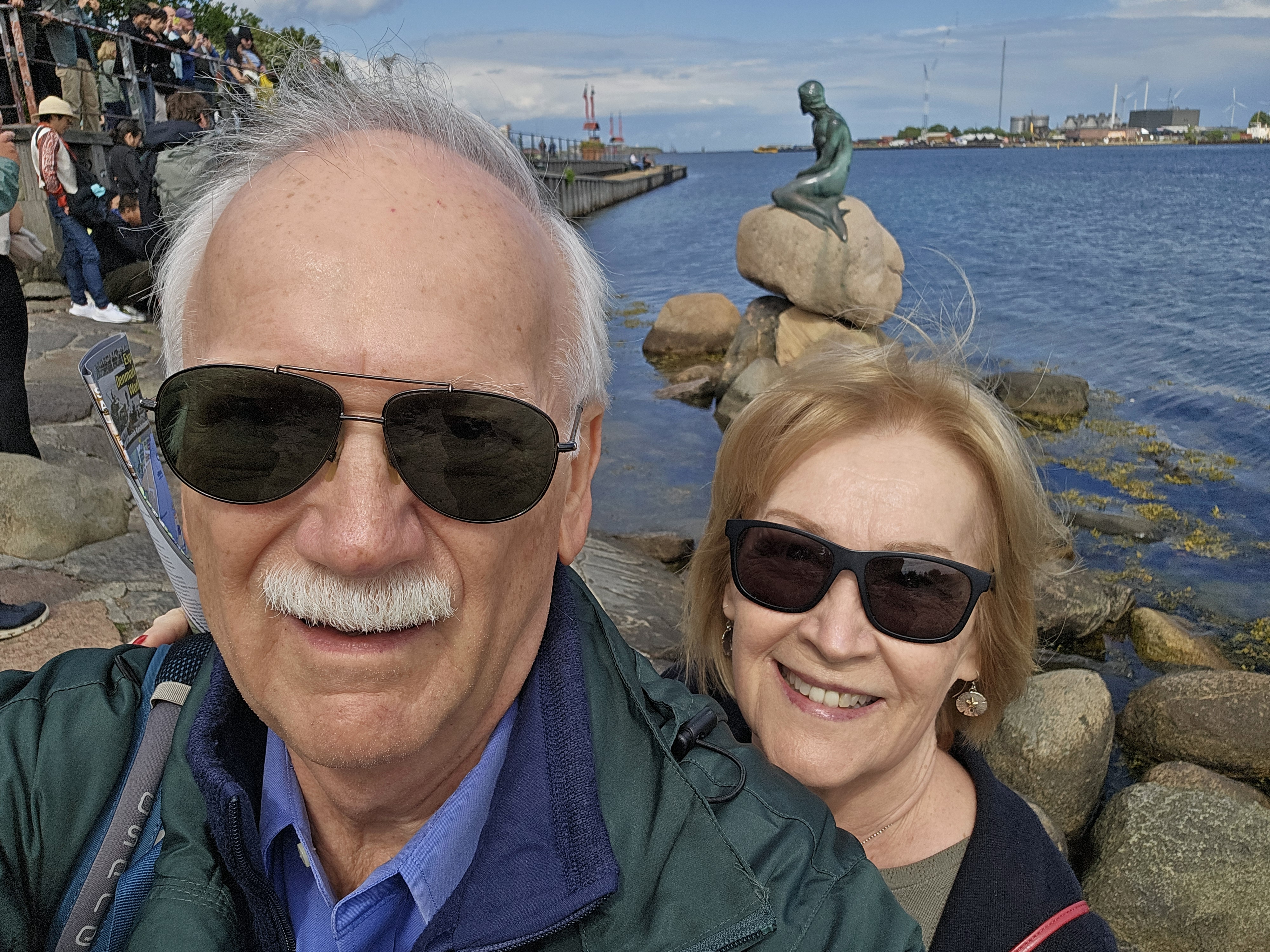
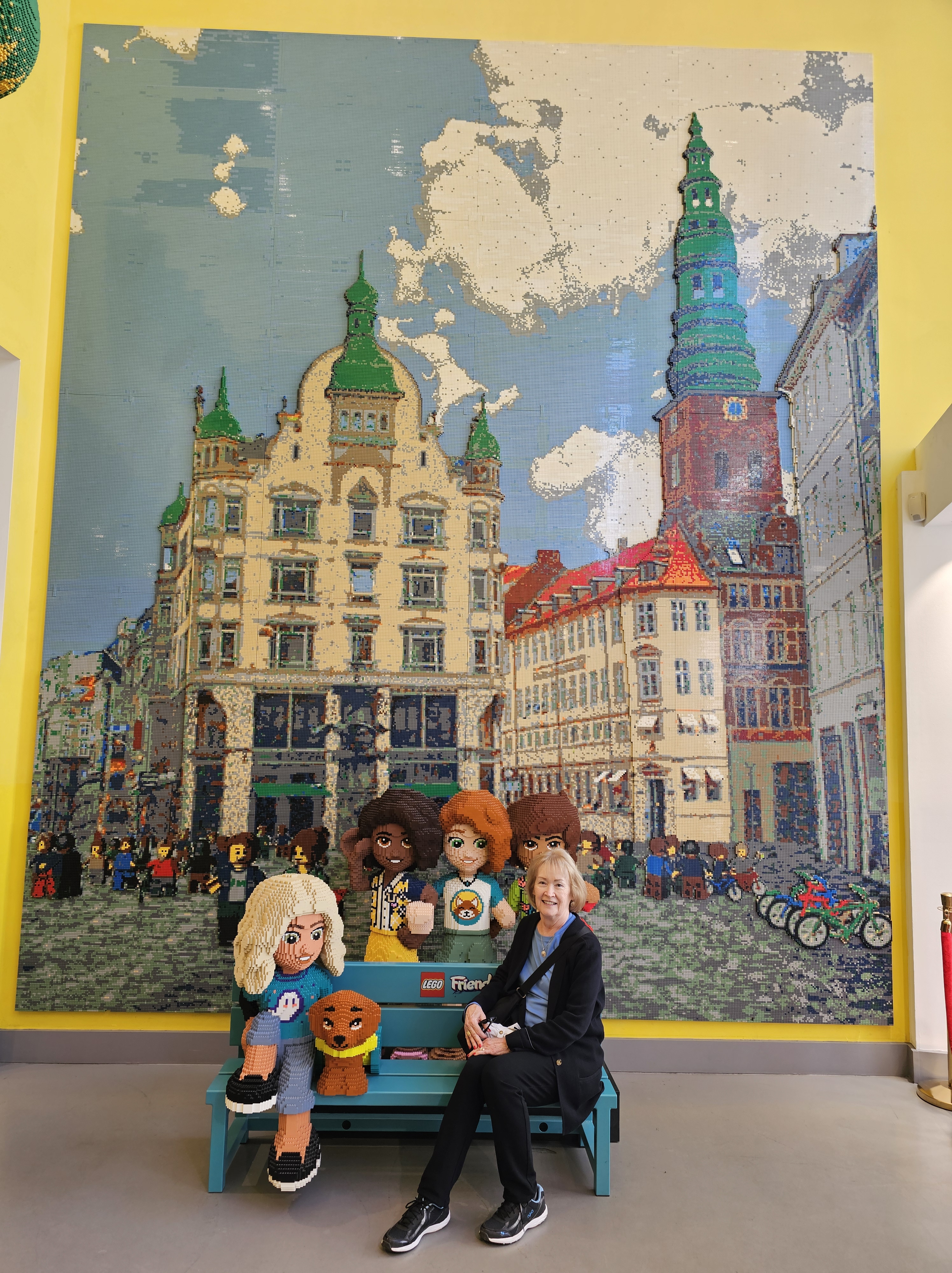
The first two days we were in Copenhagen and stayed in the Hotel Phoenix, centrally located in the old city near the royal palaces, so everything was very walkable.  We logged 22,000 steps on Monday and 13,000 steps on Tuesday, seeing many of the key sights including the Little Mermaid, Nyhavn, Tivoli Gardens, Copenhagen University district, The Strøget and the flagship Lego Store.

We had two opportunities to taste (over-eat) authentic Danish smørrebrød open-faced sandwiches, much like a meal of tapas.  One was at the 150 year old Grøften in Tivoli Gardens and the other was at Told & Snaps in Nyhavn, recommended by Danielle, which included the traditional Danish liqueur “snaps” as the name suggests.

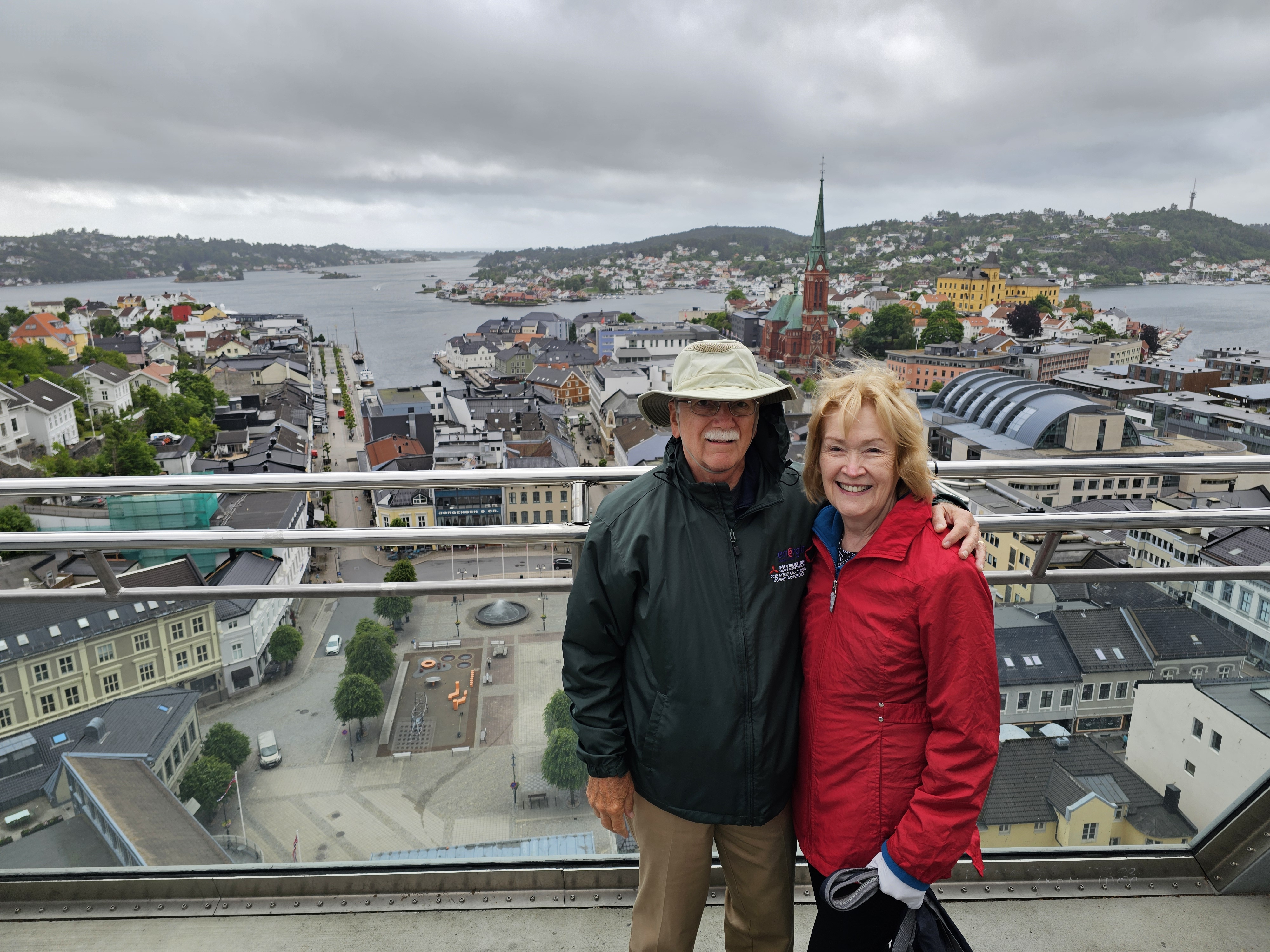
Day 3 was in Aalborg, Denmark, founded by the Vikings in the late 900’s.  We took an excursion “Back to the Vikings” to a Viking burial site, a Viking ring fortress and a re-created Viking farm from the time of Harald Bluetooth (father of the near-field electromagnetic wavelength communications on your phone and computer mouse😊).  Day 4 we did a self-guided walking tour in Arendal, Norway.

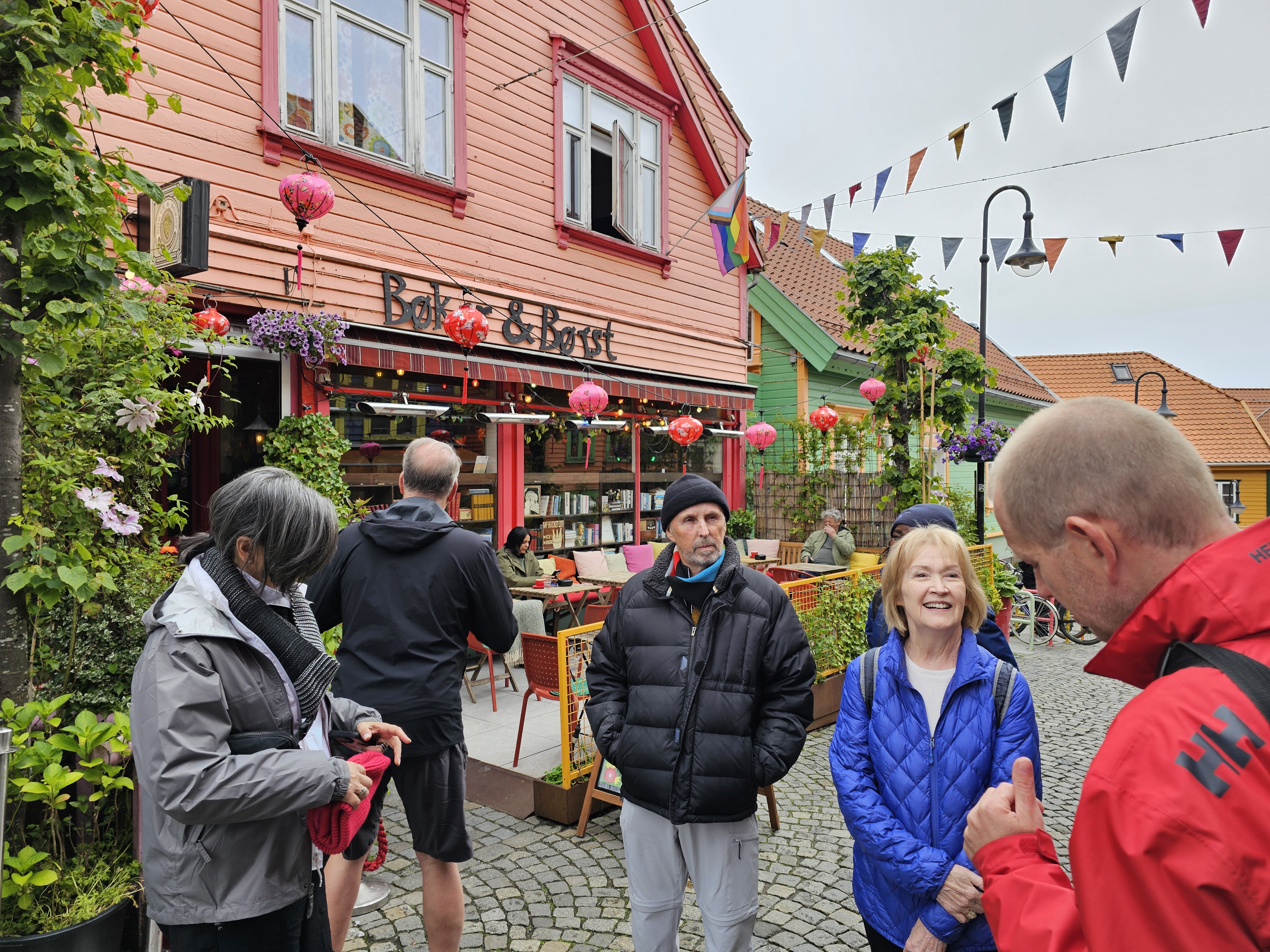
On Day 5 we joined the “Taste of Stavenger” historical and foodie walking tour in Stavenger, Norway, led by a local historian. Stavanger is the center of the Norwegian North Sea off-shore oil industry. The historian thought there might still be a lot of oil left out there.

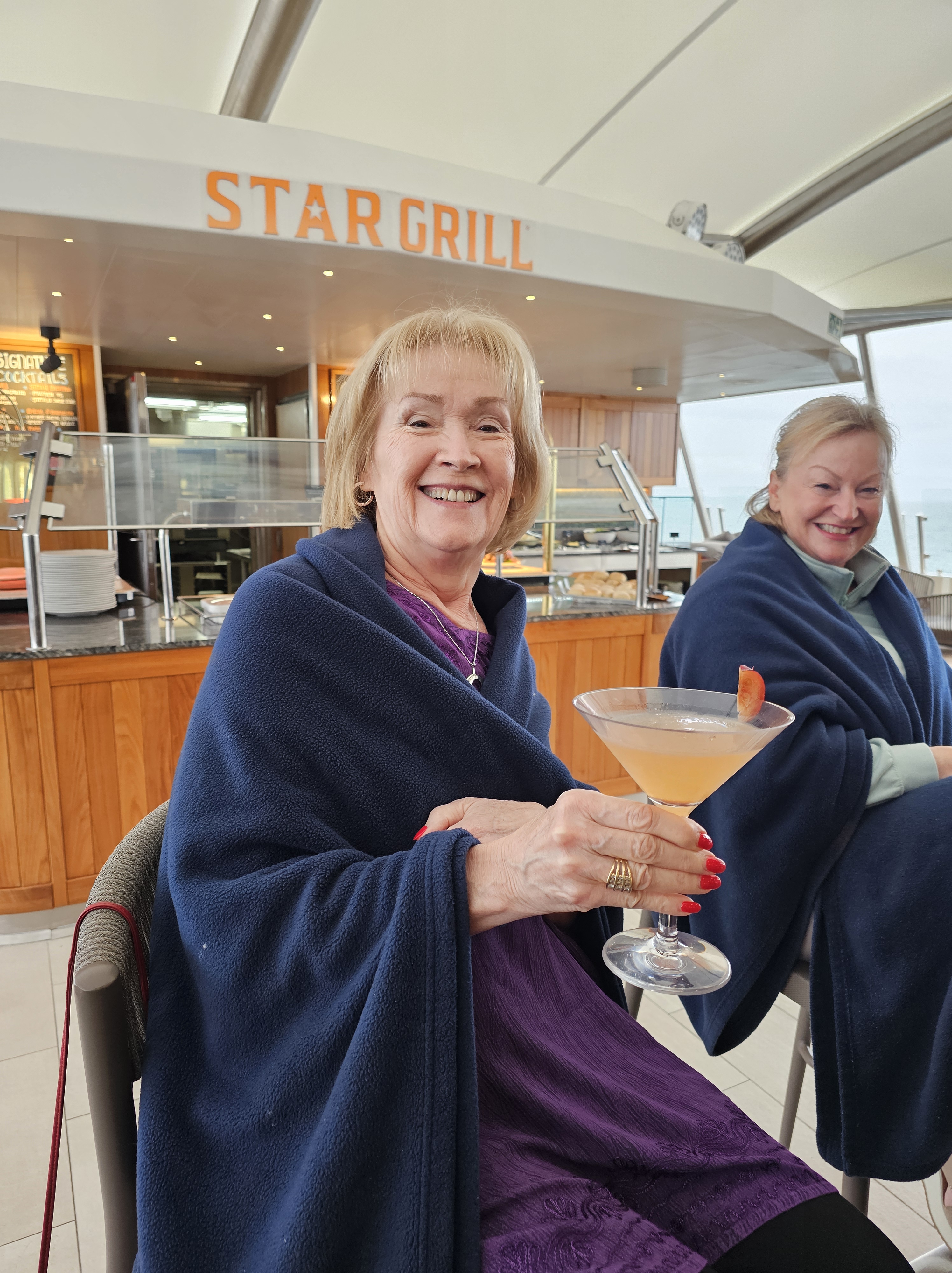
And each evening we relaxed at the Star Bar, outdoors on the top deck of our yacht, which we had come to love on our last voyage on this ship class.  Of course, that voyage was near the Equator in Tahiti at 17 degrees South latitude. So instead of shorts and tee shirts we are keeping warm this time with blankets at 62 degrees North latitude nearer the Artic Circle.

The next three days were off to the mountains and fjords, further north in Norway along the Norwegian Sea.  That is the area of the major fjords, cut by glaciers between mountains millions of years ago.  Each day we sailed 50-100 miles into a fjord to a different small town at the end of the fjord.

Day 6 was in Flam, where we took The Flam Railway, considered the most dramatic train ride in Europe, rising 2844 feet over 12 miles.  One-third of that distance is inside 20 tunnels, some of which make 180 degree turns inside the mountain.  Near the top we visited the Kjosfossen Waterfall.

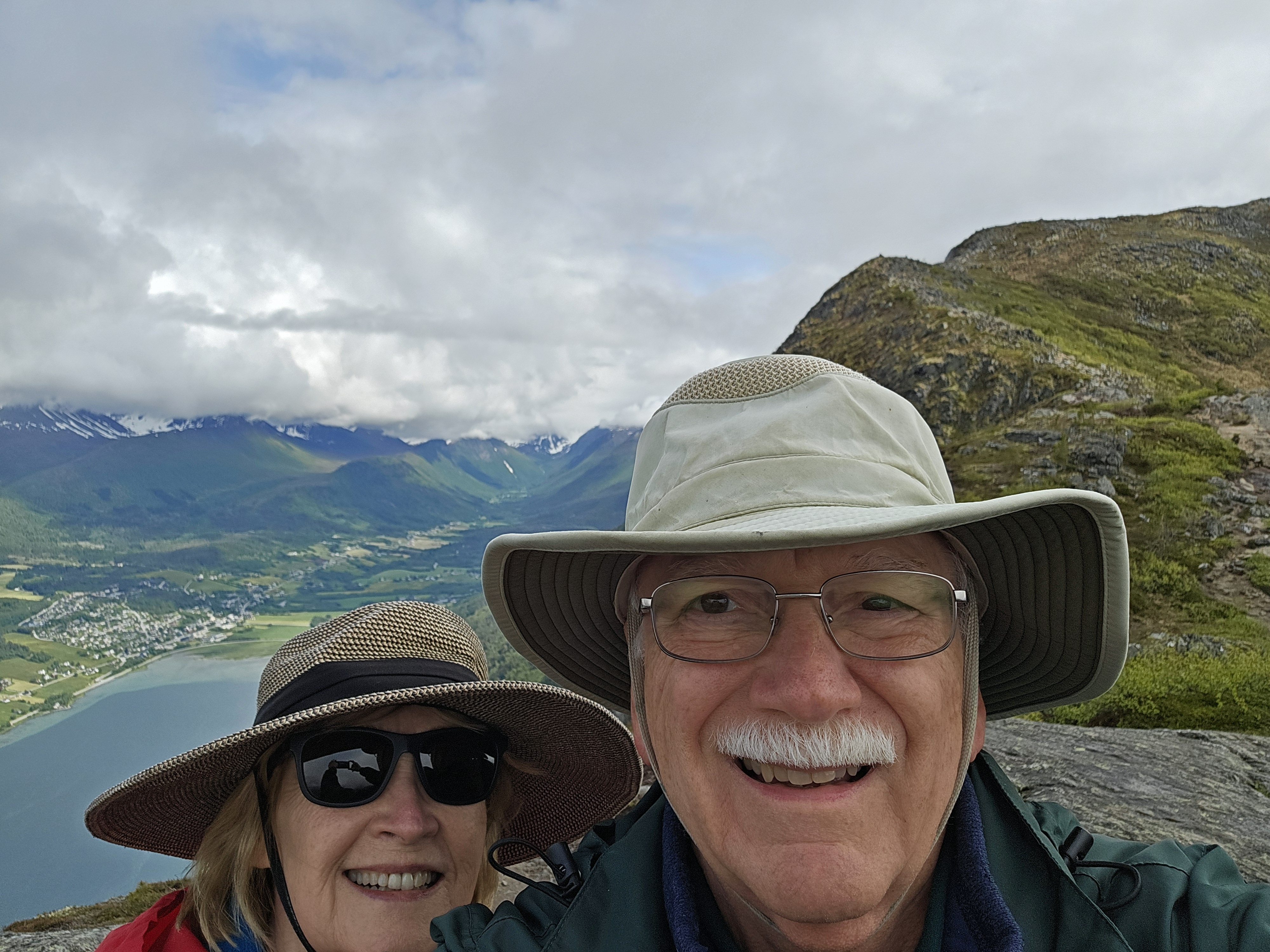
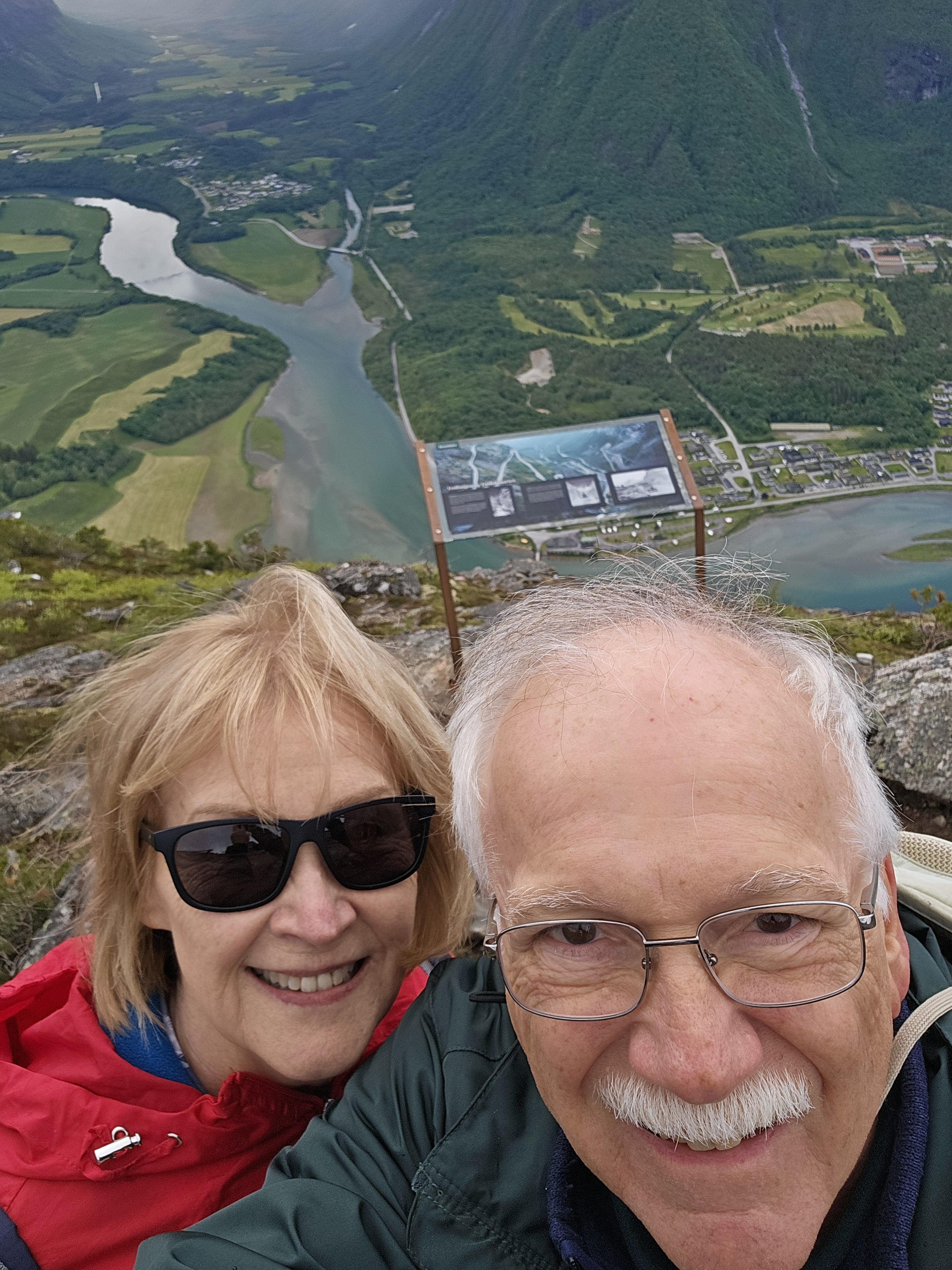
On Day 7 in Olden we did a self-guided 8 km hike up 1300 feet to the Huaren Overlook.  We had decided (actually maybe John did – but Paula was a good sport) that we had enough tours with a hundred tourists and would rely on Google Maps to strike out on our own.  It was a good change, and we saw almost nobody else on that hike – so nobody to take a picture of the two of us.  We had to rely on selfies. That evening we stayed up to watch the sunset for the first time.  Days are short here, with the sun setting at 11:21 PM and rising at 3:37 AM.  That works out to almost 20 hours of daylight.

On Day 8 we were in Andalsnes, another cute little town at the end of a fjord.  We took a cable car to the top of the town mountain and hiked around on the top of the mountain.  Views were spectacular.

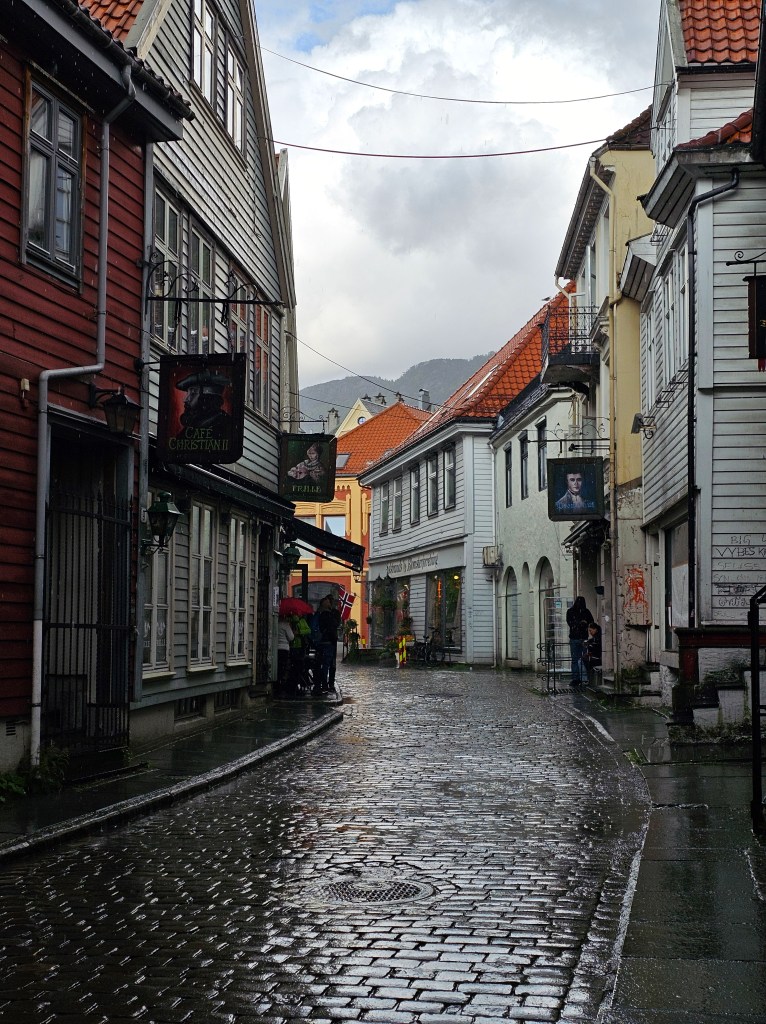
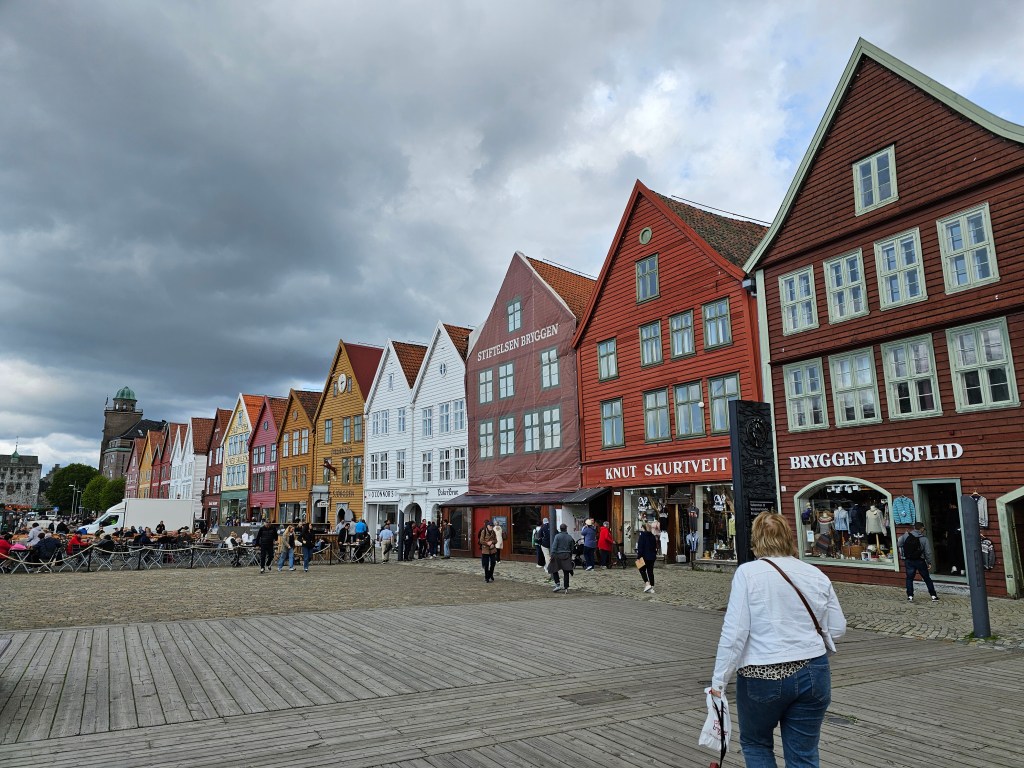
Day 9 was our last day of the expedition, in Bergen, Norway, and we flew back home from there. Bergen (or Bryggen) is Norway’s most international city, packed with history and tradition. It became an important European city of trade in the 13th Century as the Hansas opened one of their four offices on the wharf, making Bergen a European hub of commerce, seafaring and craftmanship. Today Bryggen is a reminder of the city’s importance as a part of the Hanseatic League, and has a place on UNESCO’s World Heritage List. A stroll through the back streets of Bryggen brings you back to the Middle Ages, as a lot of the architecture is preserved or rebuilt as it was originally built.

Another good trip. Does it seem like we are recommending all of them?

Colombia and Snake Rivers of Idaho, Oregon and Washington 2025

In April we took another Lindblad/National Geographic expedition, this time to the US Pacific Northwest titled “Colombia and Snake Rivers: Food, Wine, and History”.

We arrived in the Lewiston, Idaho and Clarkston, Washington.  The city names come from their association with the Lewis and Clark Expedition of Discovery in 1803-1805, shortly after much of the western US was obtained from France by Thomas Jefferson via the Louisiana Purchase. Our expedition followed the route they followed downriver to the Pacific and back upriver to the Continental Divide. We had a historian accompanying us who gave a very relevant lecture every day.

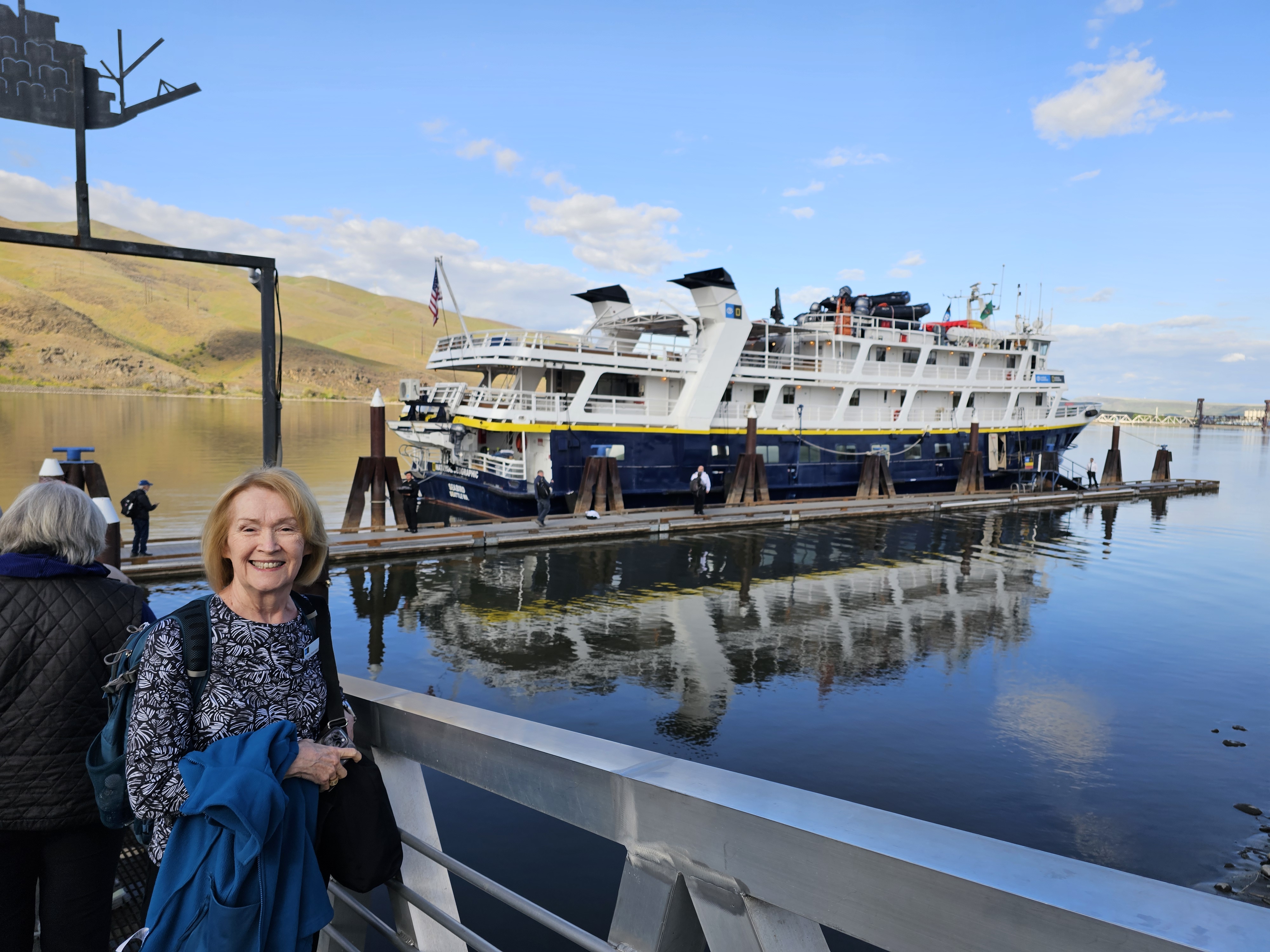
We boarded our expedition ship in the evening, the National Geographic Sea Bird

The next day we took jet boats 50 miles up into Hells Canyon, a 125 mile-long canyon that was carved by the waters of the Snake River and at 7993 feet is North America’s deepest river gorge – most of it inaccessible by road.  For comparison, the Grand Canyon is only 6093 feet deep.

After returning to the ship we had three lectures.  One from a Nez Perce Indian storyteller.  One by a local winemaker.  And one by the accompanying National Geographic photographer on techniques to take pictures with our phones.

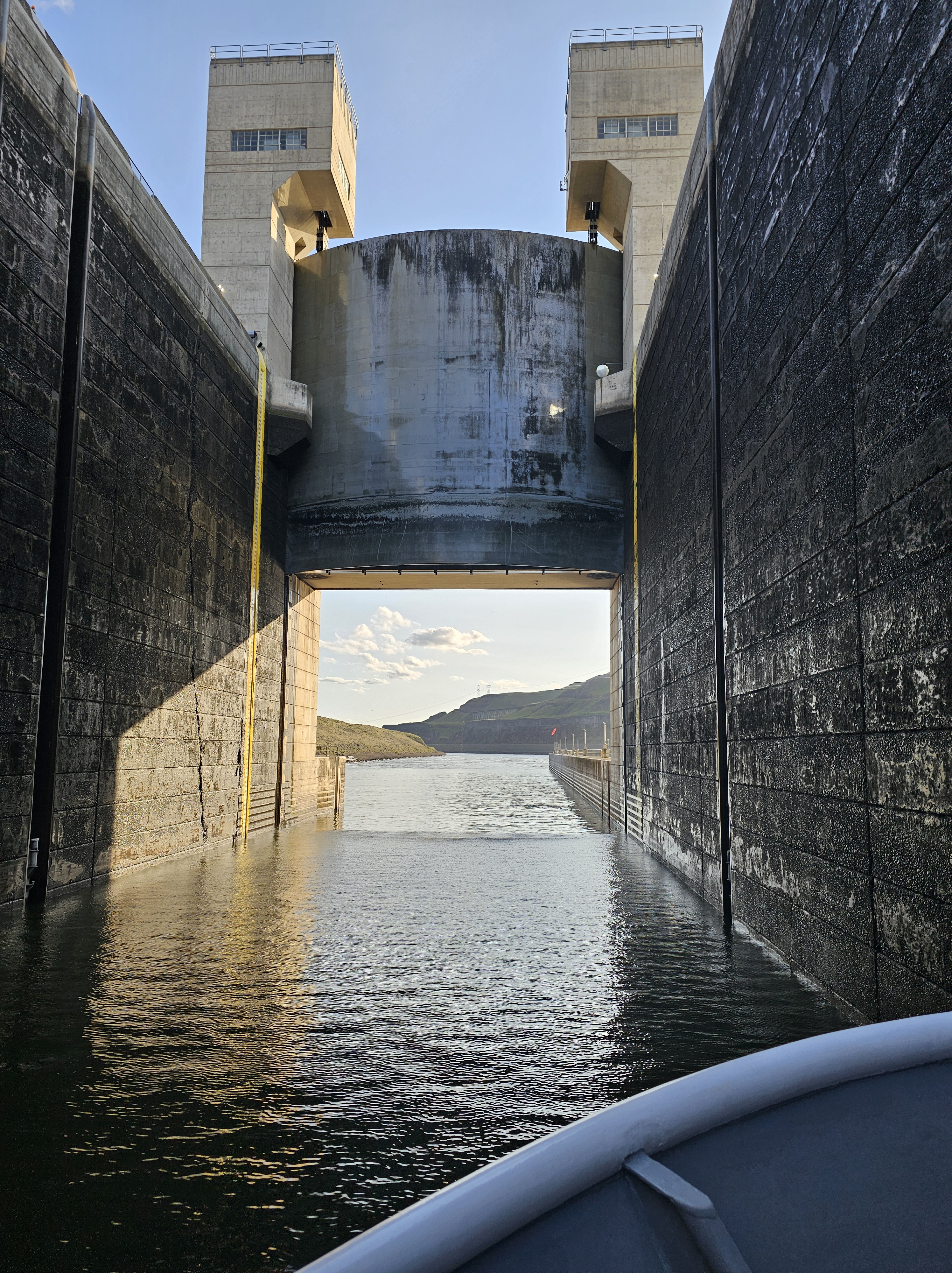
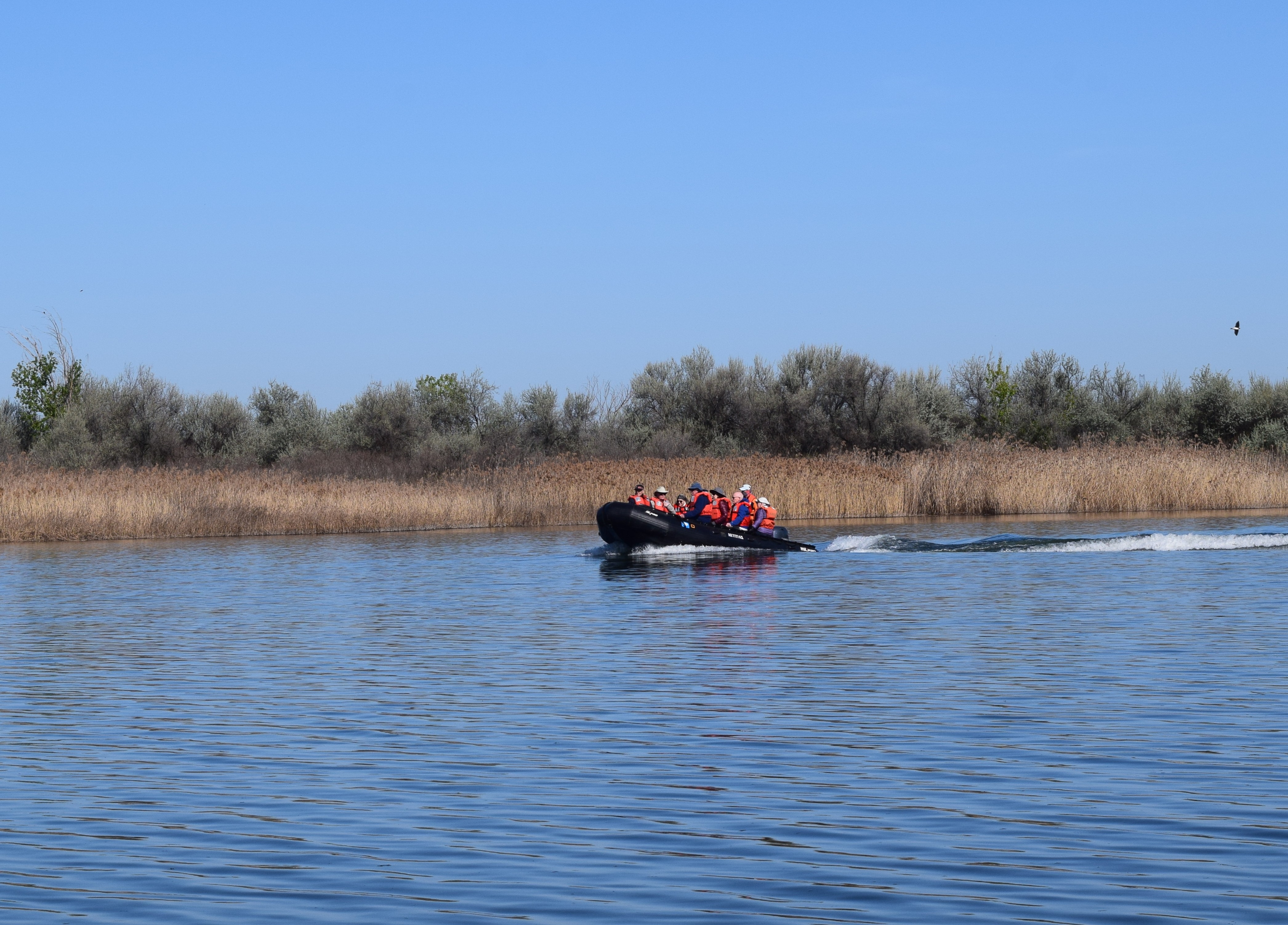
On Day 3 we visited the top of Palouse Falls and then took the Zodiacs up the Palouse River for birdwatching and inspection of the local geology.  That evening we were on deck while we passed through one of several locks on the Snake and Columbia Rivers that we traversed, each dropping us about 100 feet as we traveled from 750 feet above sea level in Idaho to the Pacific Ocean in Washington.

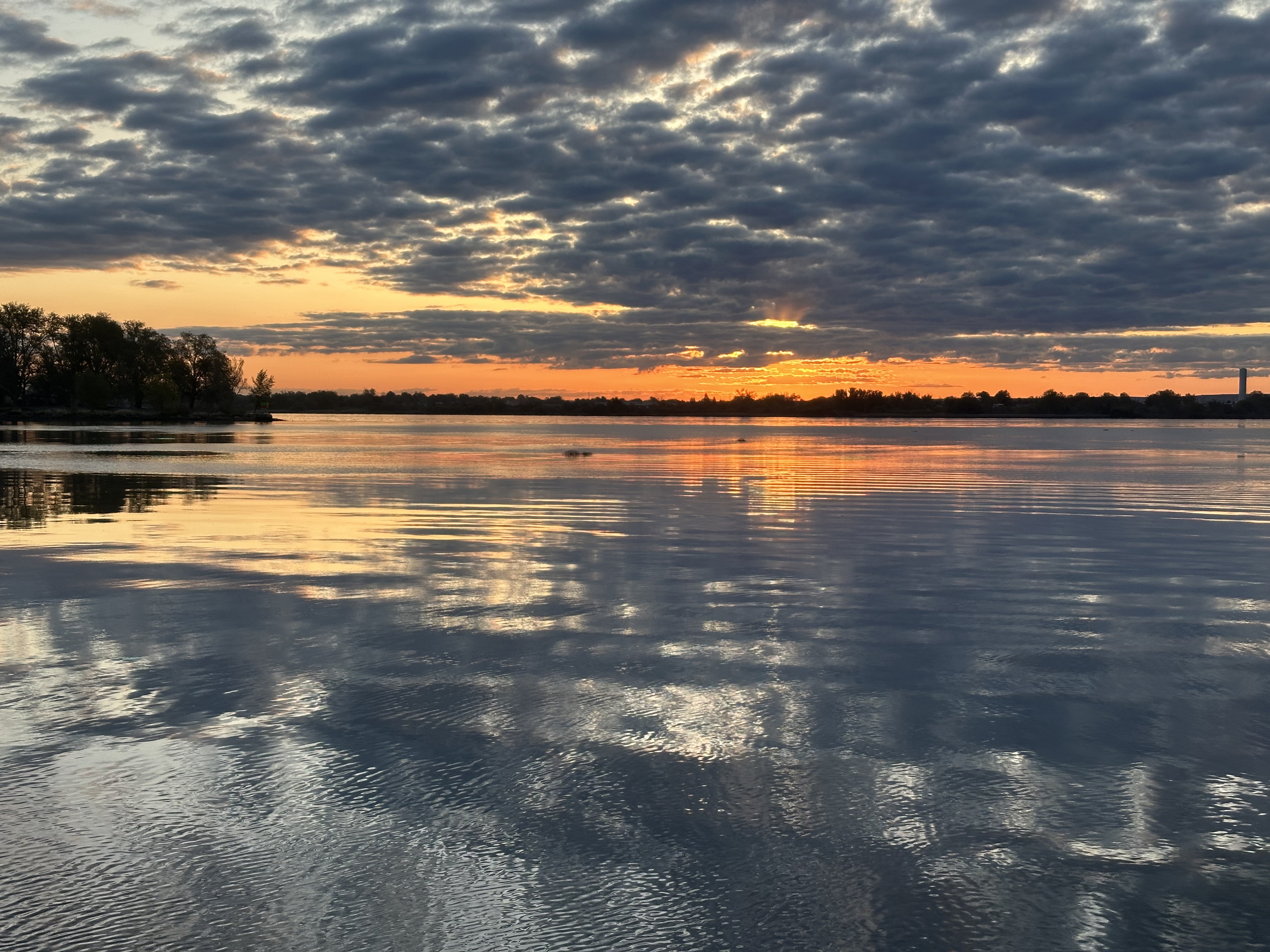
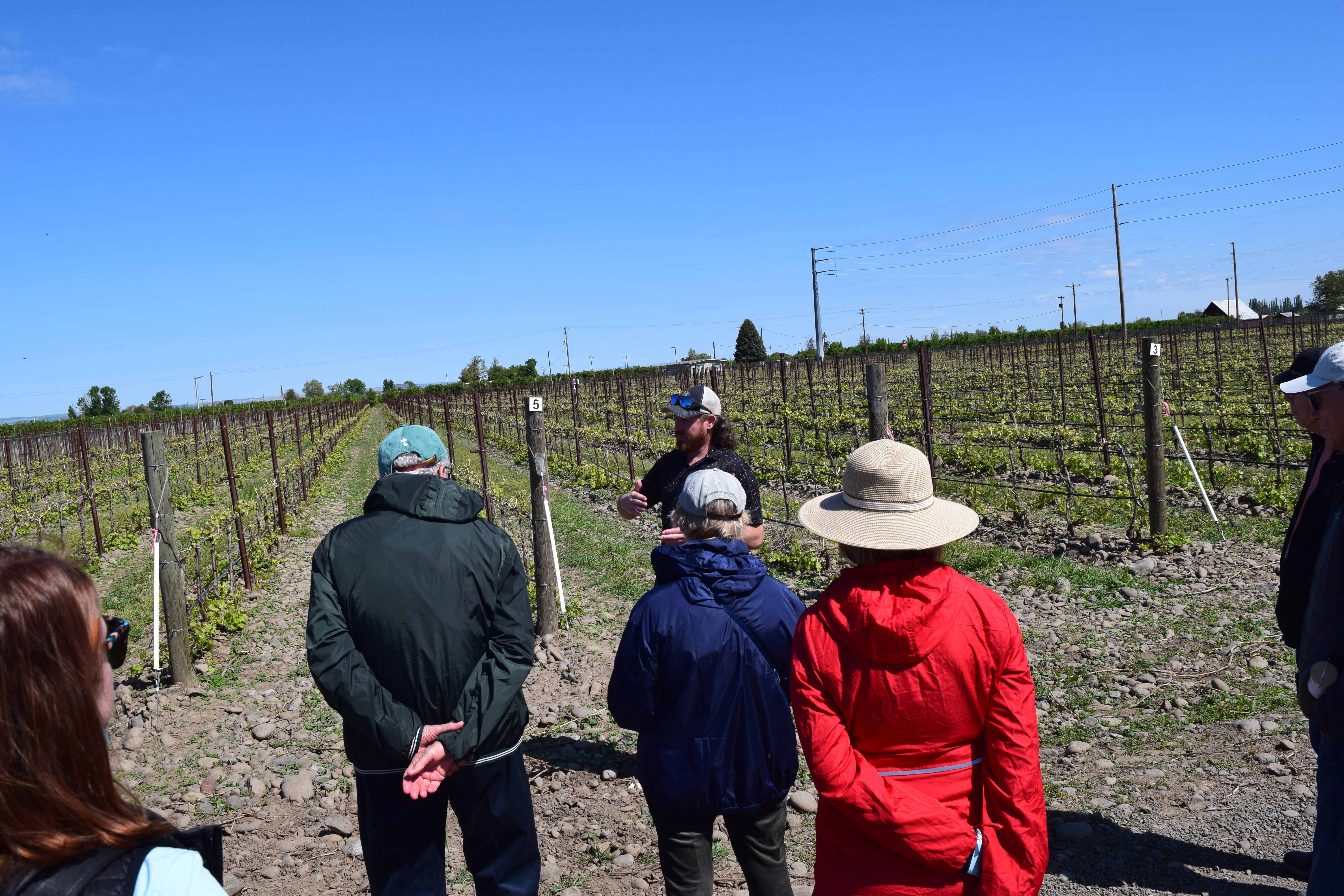
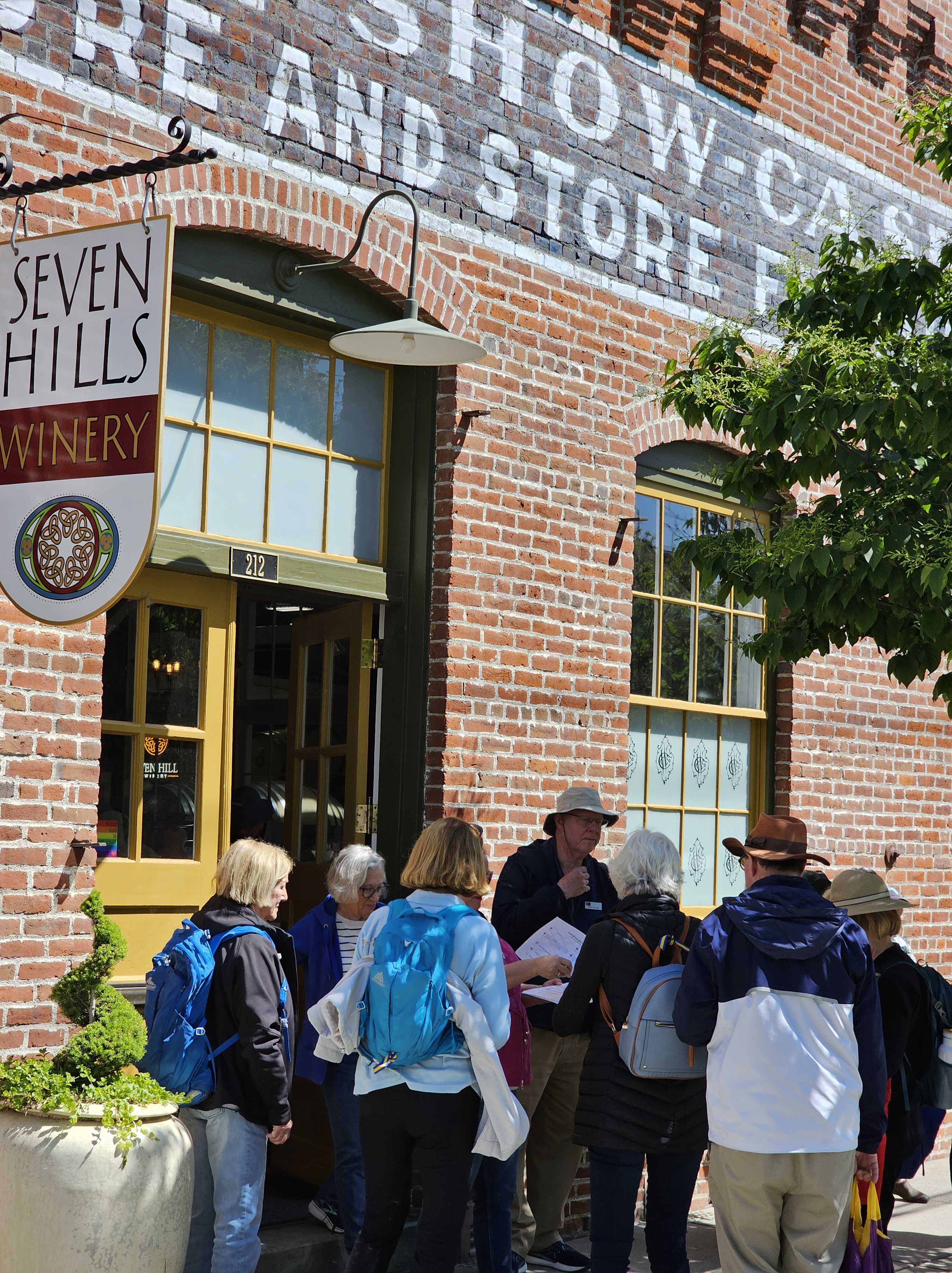
On Day 4 we viewed a spectacular sunrise from the window in our cabin and then were transported to the cute little town of Walla Walla which has been reincarnated as a vineyard and winery destination, with approximately 130 small wineries.  In the morning we inspected the varied estate vineyards of the Seven Cellars Winery with the winemaker, followed by lunch and a guided tour of the winery in town.

On Day 5 we continued our expedition, now on the Columbia River running between Washington and Oregon.  In the morning we went out in the Zodiacs with a naturalist to view wildlife in the Blalock Islands.  Among other things our wildlife sightings included an American Bald Eagle and many “orange-breasted rubber-neckers”, which are plentiful in the most beautiful parts of the world.  They are social animals that practice mimicry and will often wave back if you wave at them. 😊

In the afternoon, we hiked to the top of the highest mountain on Crow Butte Island, created in the middle of the Columbia when the dams were built and flooded the rest of the valley.  Our ship is below us in the background of this picture.  The panoramic view from there included a massive wind farm and several Bonneville Power Authority high voltage transmission lines.  Beautiful….(to John anyway).

Lectures today included one from the naturalist on the challenges facing migrating salmon and their significant predator orca whales, as well as another in a series from the expedition historian after dinner.

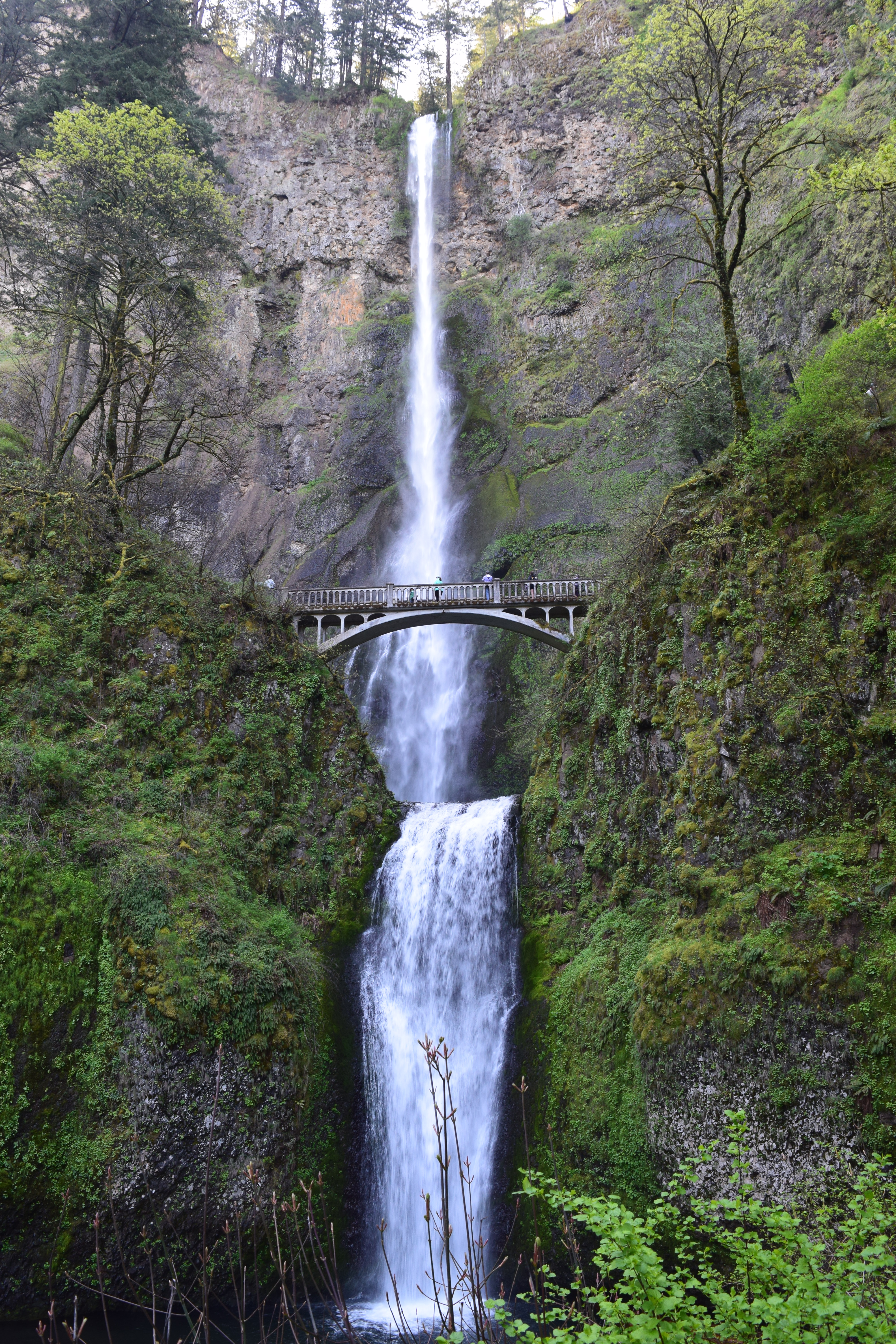
On Day 6 we docked at Hood River, Oregon and travelled by coach to the 620 foot tall Multnomah Falls, the most visited natural recreation area in the Pacific Northwest, getting there early before too many tourists arrived.

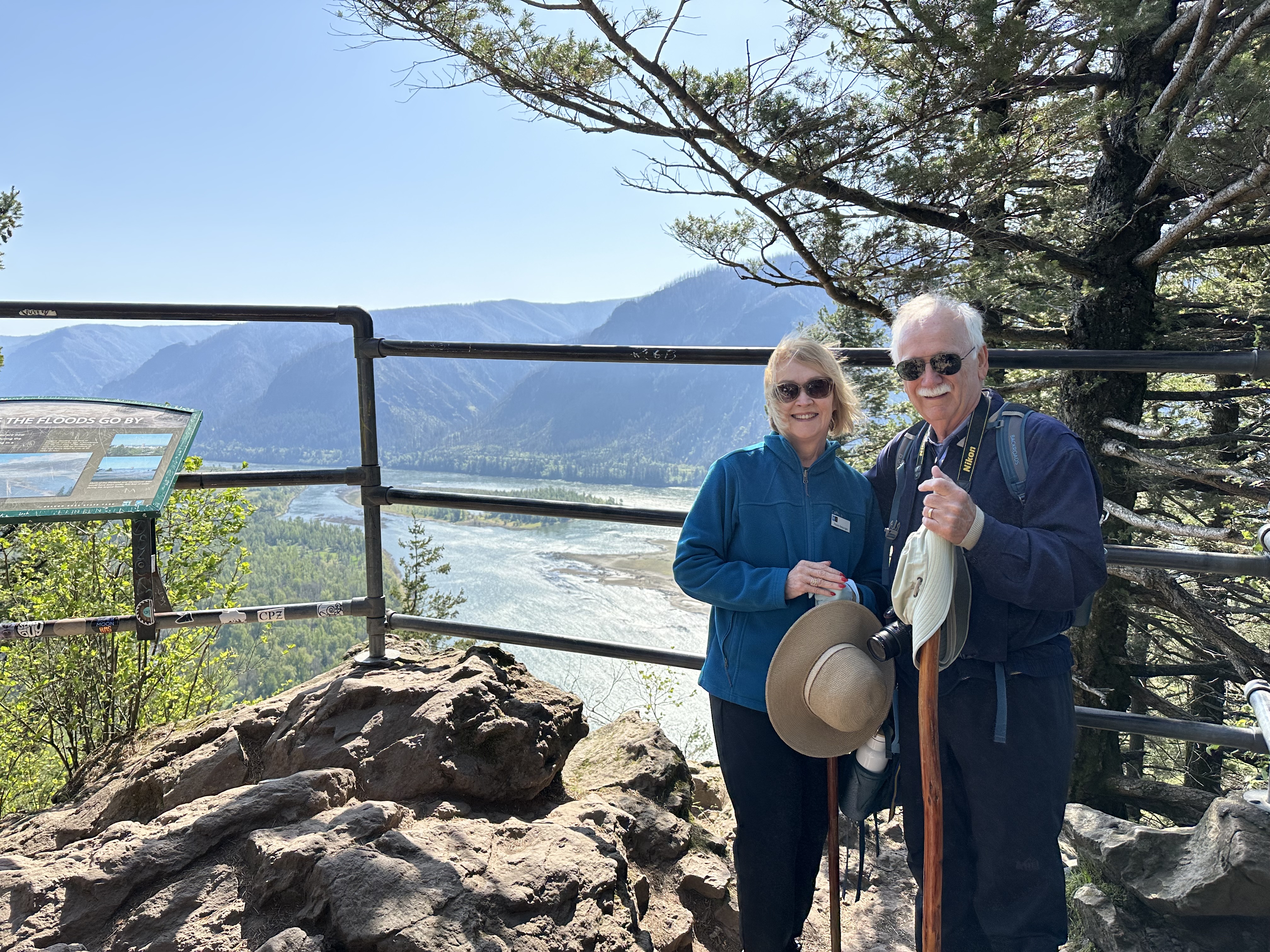
After a lunch winetasting at the Columbia Gorge Museum we did the “energizing” summit trek to the top of Beacon Rock on a trail crated in 1915 with a vertical rise of 575 feet incorporating 53 switchbacks in the trail.  The view of the Columbia gorge and Bonneville Dam from the top was spectacular.

On Day 7 we reached the Pacific Ocean at Point Disappointment in Washington, which was where Louis and Clark’s “Corps of Discovery” reached the ocean with the written exclamation: “Ocien (sic) in View:  Oh the Joy!”

In seven days we had travelled downriver about 475 miles from the near-desert of Lewiston, Idaho where annual rainfall is 6-9 inches to the coast in Washington’s temperate rainforest where annual rainfall averages 56 inches.  And we had great weather all the way with the sun appearing most of every day.  There were 58 of us on the expedition and we were well-entertained and taught every day by the accompanying naturalists, wine expert, photographer and historian. A good trip that we highly recommend. 

Patagonia in Argentina and Chile 2025

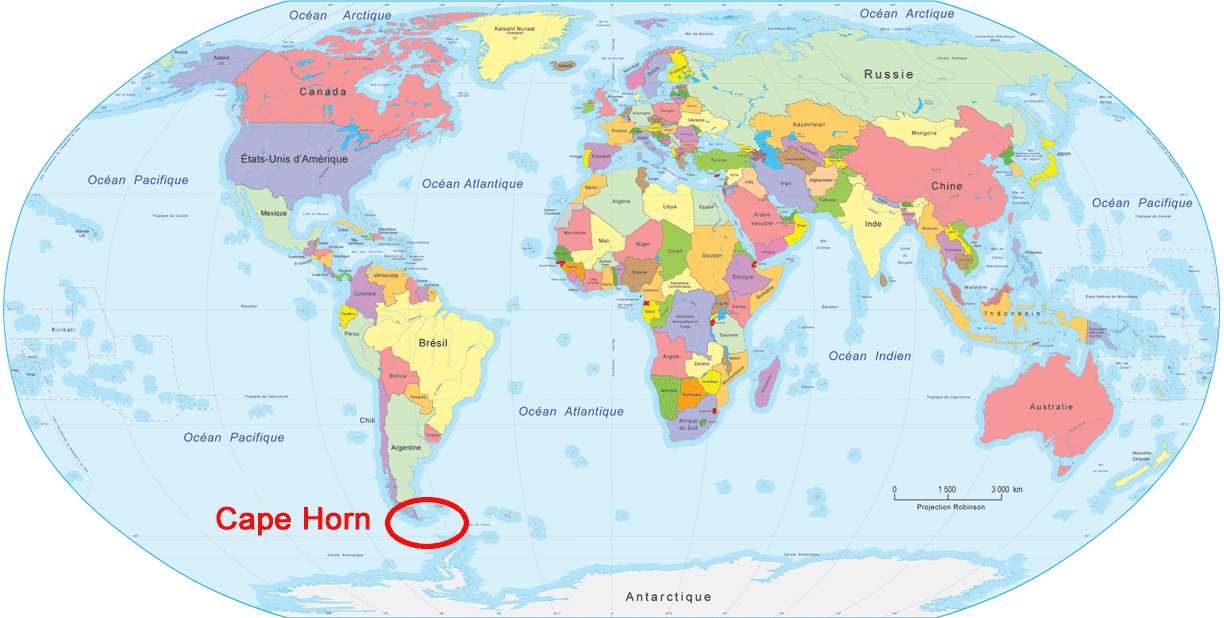
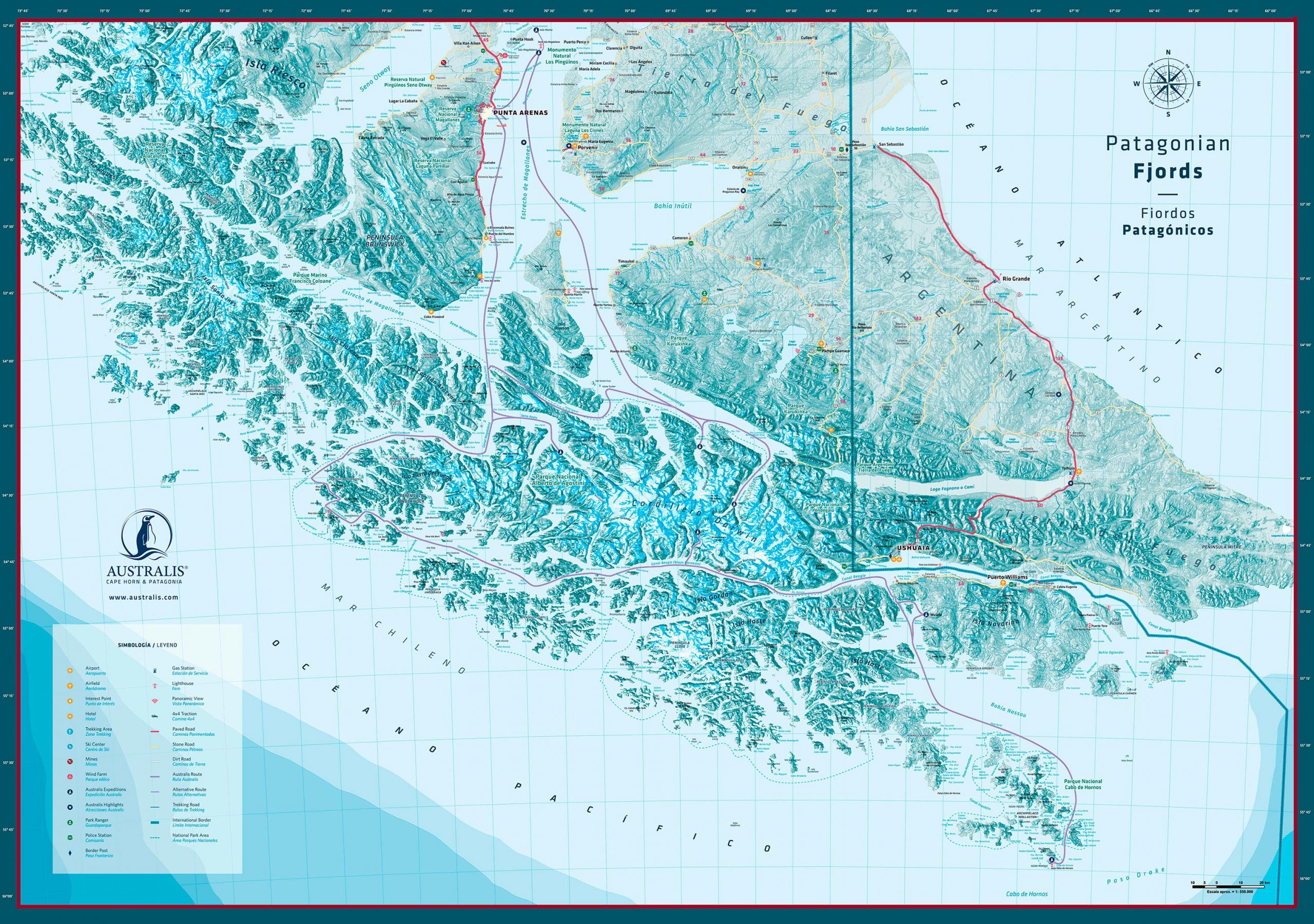
On this expedition we headed with our friends Peg and Roger to Ushuaia on Tierra del Fuego in Patagonia, known as the “Uttermost Part of the Earth”.  Ushuaia is the southernmost city in the world, with the next stop going south beyond nearby Cape Horn being Antarctica.
On Day 1 we flew 5000 miles from Orlando to Buenos Aires, Argentina.  We had been there twice before in 2012 for a Conference, but this time we stayed in the very nice neighborhood of Palermo which we highly recommend.  We took a Palermo Food Tour which covered five restaurants and a wonderful range of Argentinian foods.  Soccer is a big deal here and we didn’t see a TV that didn’t have a soccer game playing on it.  As it turned out, the steak restaurant on the food tour was that of the mother of Maradona, the famous Argentinian soccer player who was a coach of Messi!

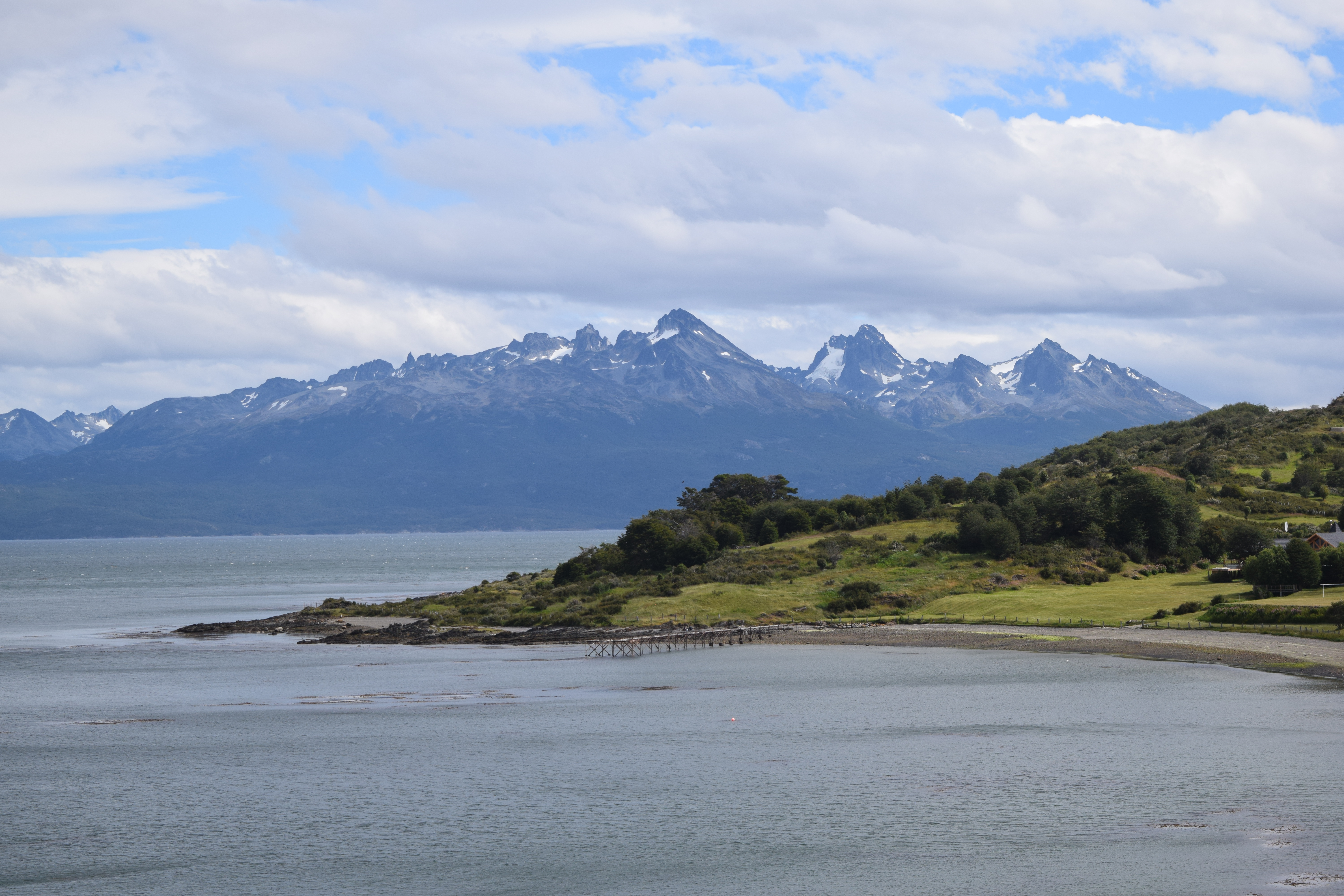
On Day 2 we flew another 1500 miles south from Buenos Aires to Ushuaia at the very southern tip of South America.  Our hotel was directly on the Beagle Channel, of Charles Darwin fame, and it was sunny and 63 degrees F.  The locals are saying this is the best day of the summer so far!  But the surrounding mountains have a lot of snow on them!

View from our hotel room on the Beagle Channel

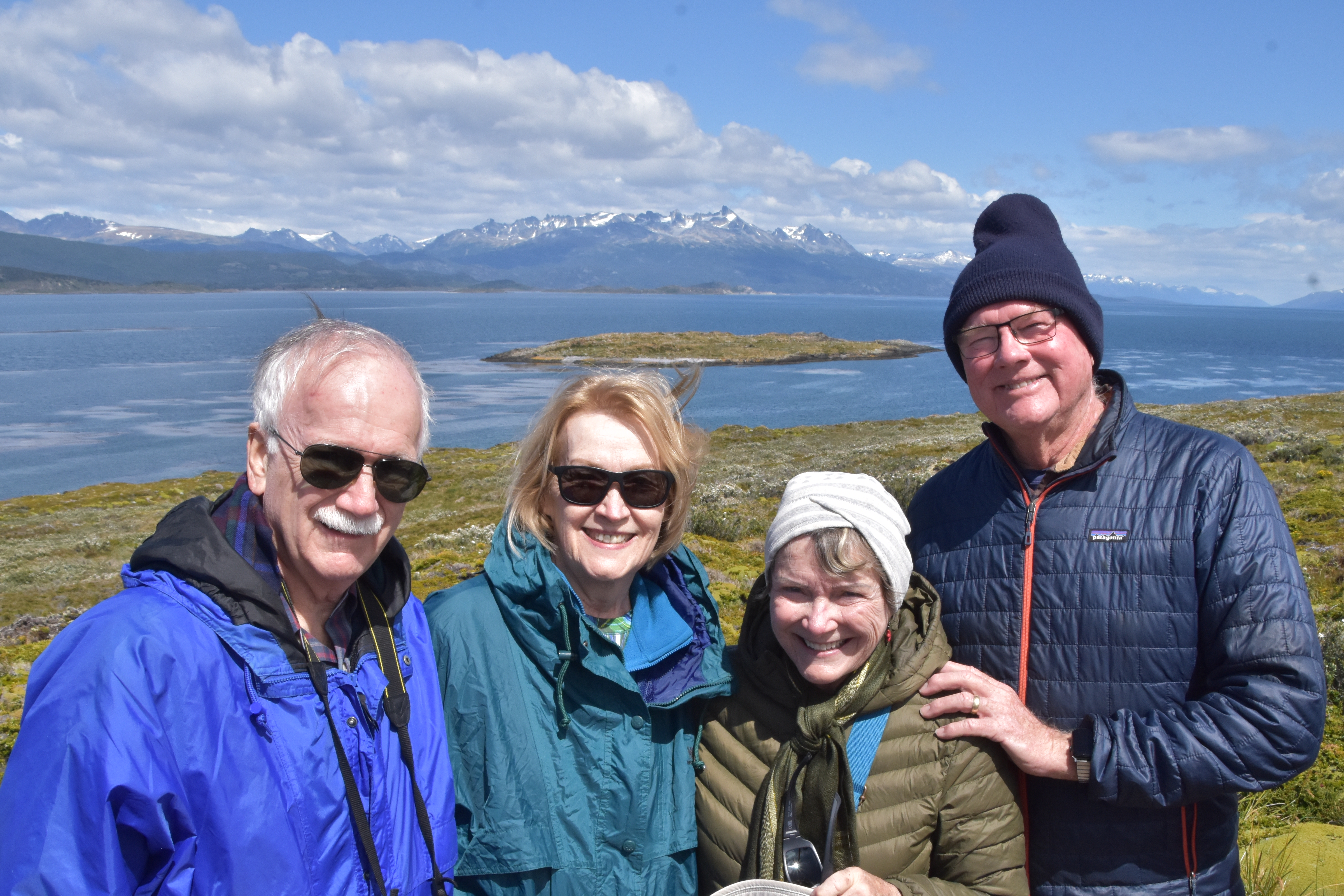
 On Day 3 we went on a motorboat cruise of the Beagle Channel, heading east towards the Atlantic.  The HMS Beagle made three visits to map the area in the 19th Century.  Hence the name Beagle Channel.  Charles Darwin was the naturalist on the third voyage, which took 5 years and provided much of the information for his later development of his theory of evolution.  Ushuaia is in the center of the channel, about 90 km east to the Atlantic and 90 km west to the Pacific.  The channel was formed by a glacier at the southern end of the Andes mountain chain.  East from Ushuaia is the Faro Les Eclaireurs, known to the Argentines as the Lighthouse at the End of the World.  It is on a rock that was heavily populated with imperial cormorants at one end and a harem of sea lions at the other end. We got off the boat to hike to the top of the highest mountain on Bridges Island, which was named for the Anglican missionary family that arrived in the 1870’s to minister to the local indigenous tribes.  John is reading the book “Uttermost Part of the Earth” authored by E. Lucas Bridges of that family.  He is son of the missionary Thomas Bridges and is known as the “third white native of Ushuaia”.

On Day 4 we were still near Ushuaia and went trekking in Argentina’s Tierra del Fuego National Park.  Late in the day we boarded our expedition ship Ventus Australis and set sail for the Patagonian Fjords and Chile, the country where we spent the balance of our stay.

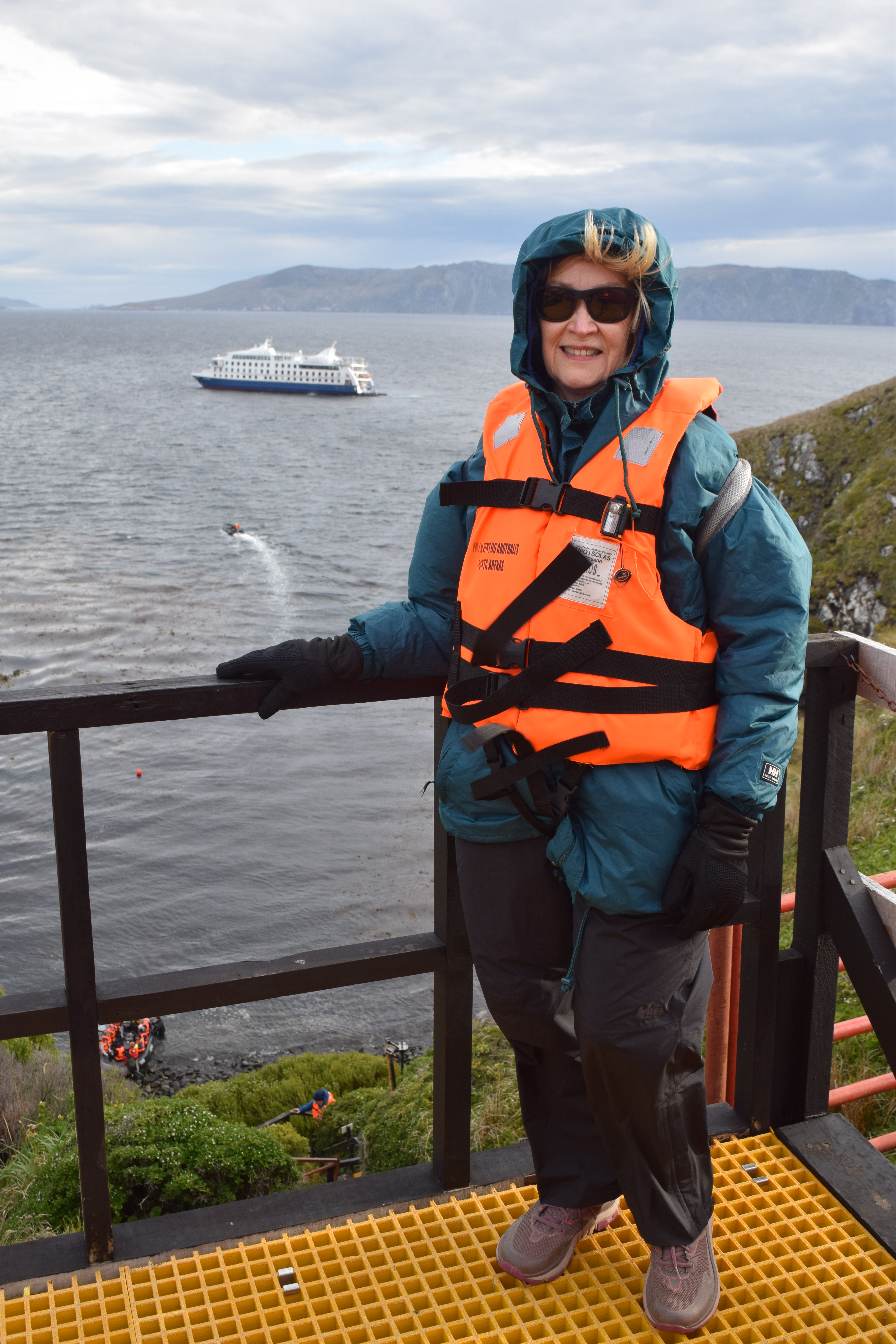
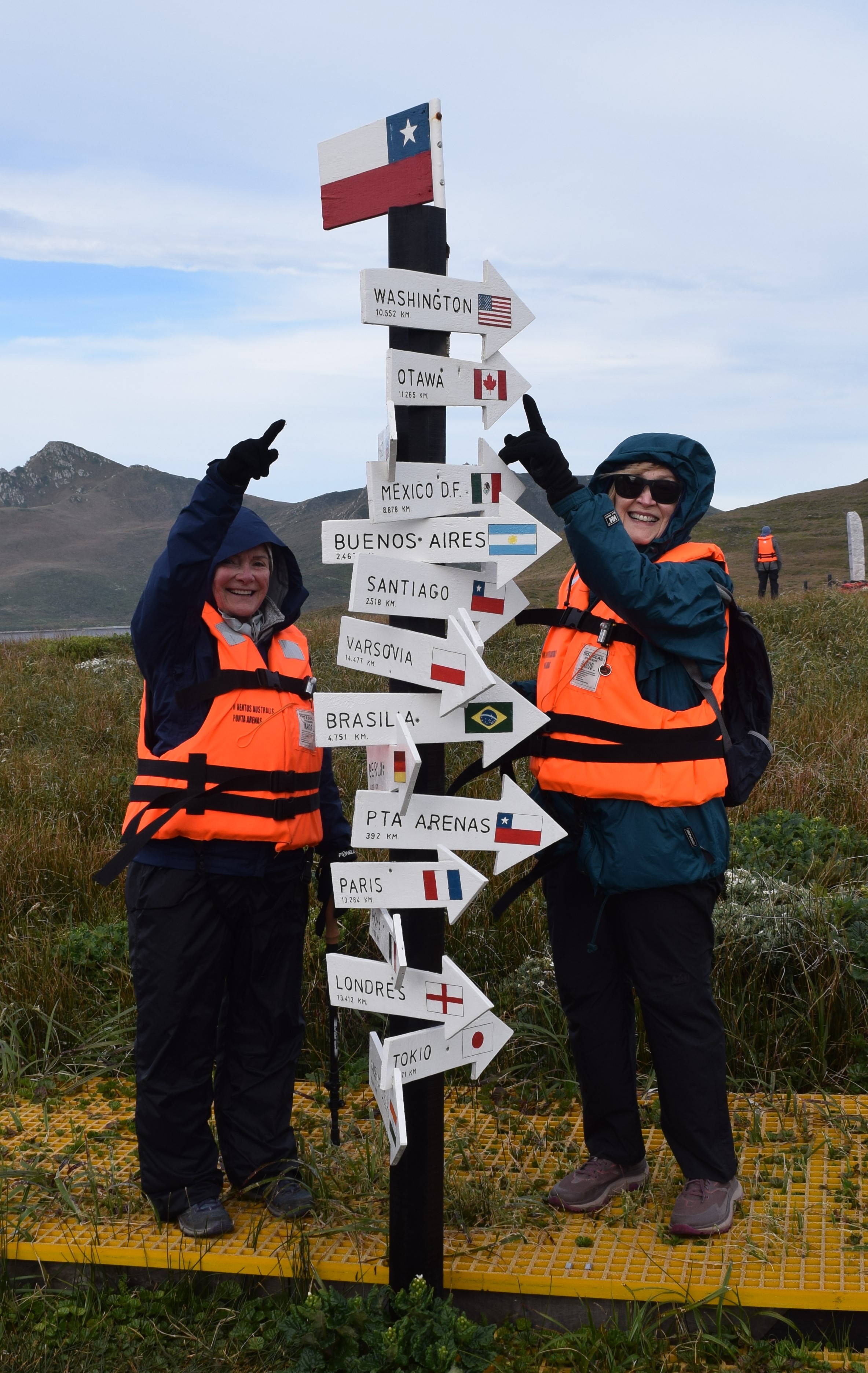
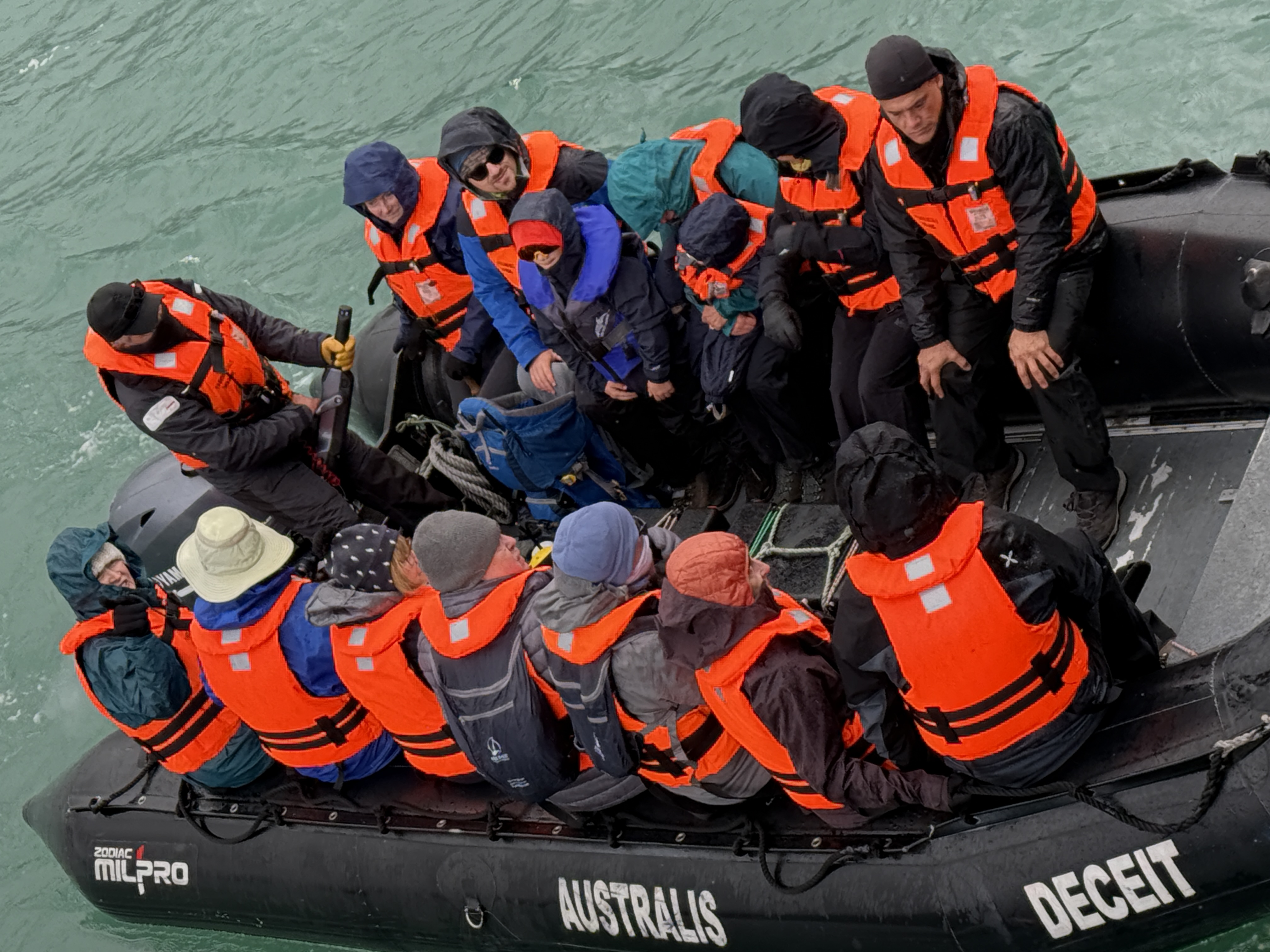
Bright and early on Day 5 (6:45 AM) we boarded zodiacs to do a semi-dry landing on Hornos Island at the tip of Cape Horn, the last land before Antarctica .  We have heard various claims of the number of ships that have sunk trying to round Cape Horn since it was discovered by the Dutch in 1616 which range from 700 to 4000 ships.  It was early because the captain said conditions for landing were going to be favorable early but deteriorate later.  One of the criteria for favorable landing conditions was wind gusts less than 45 MPH!  We
were told that our visit was on an unusually nice day. In the afternoon we hiked at Wulaia Bay.

On the evening of Day 5, we were at the ship’s bar when the water got rough and the ship assumed a continuous angle about 20 degrees off horizontal.  That was a bit of a concern until the bartenders assured us it was no problem…saying it was normal.  But their credibility came into question a few minutes later when all of the wine glasses slid out of their restraining rails and crashed to the floor causing a need to close the bar.  We were told the next morning that we had been crossing an open, exposed area as we re-entered the Beagle Channel where the wind was 80 knots onto our port side.

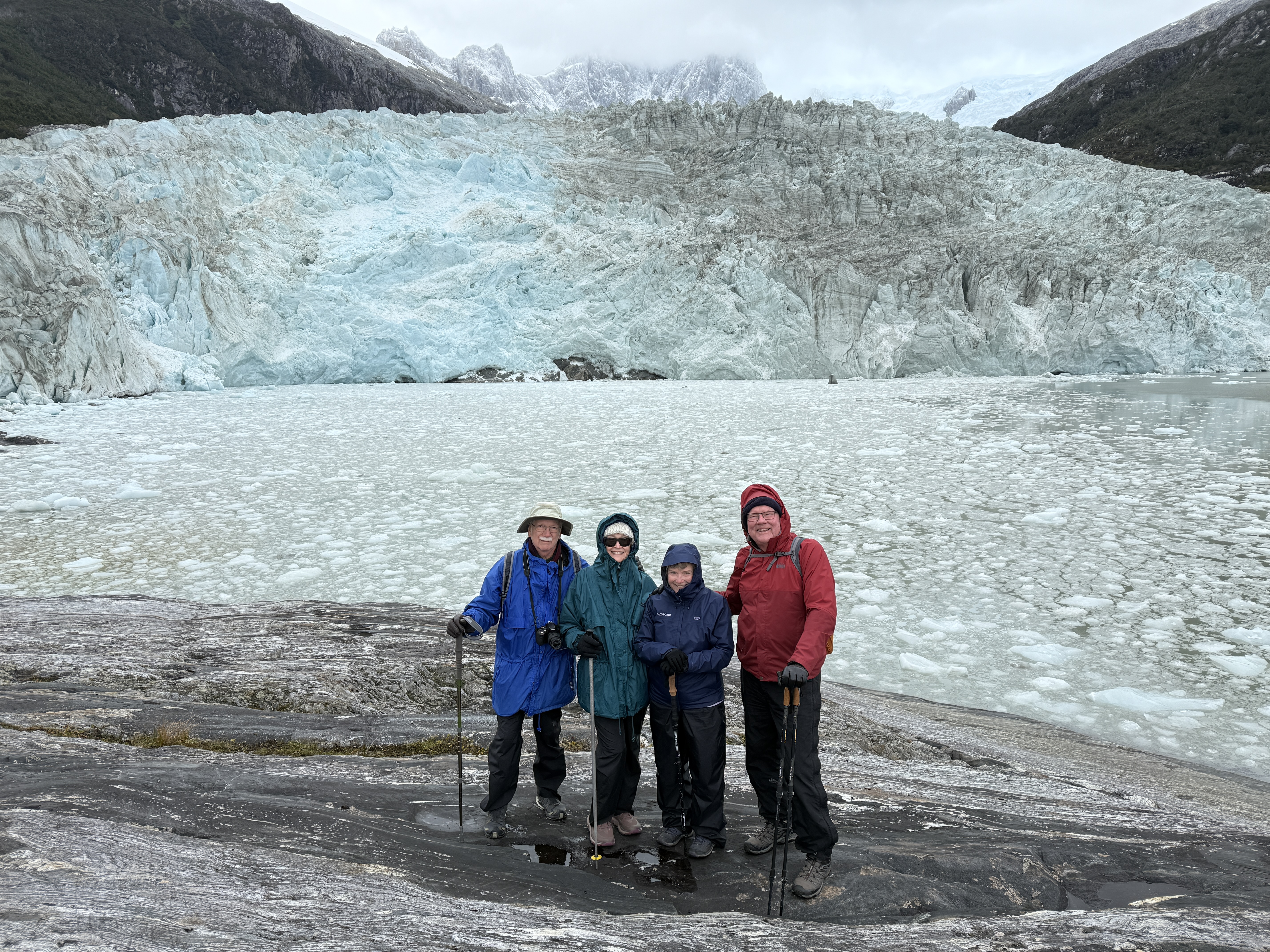
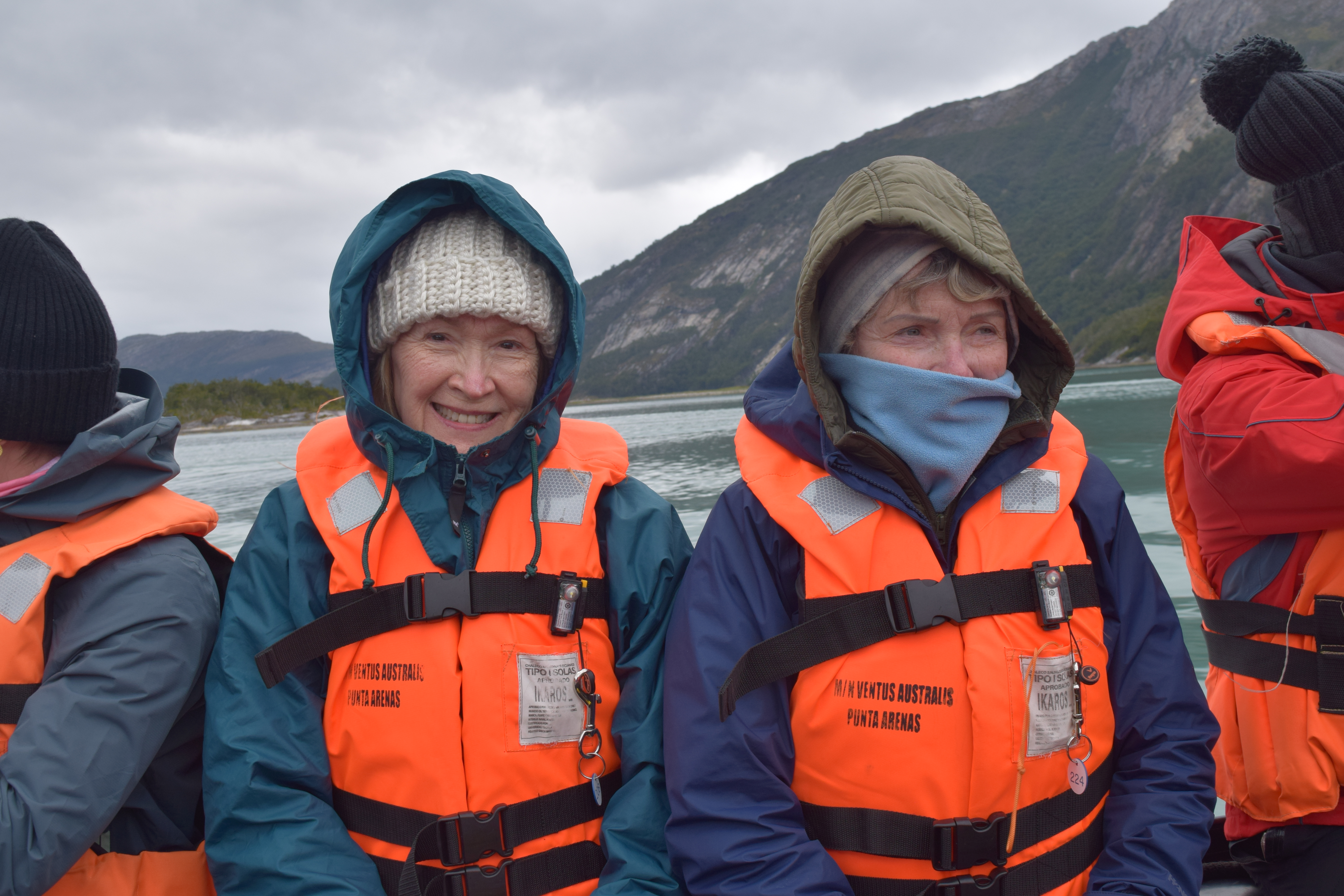
By morning things had calmed down and we visited a total of four glaciers over the next two days.  We hiked to the bases of two of them, and stayed on the zodiacs which took us to the bases of the other two.  We got some good video footage of a couple dramatic “calving” events when the glacier created loud cracking sounds, large portions broke off, and crashed into the water in front of us!  For the largest of them the zodiac driver had to quickly
reverse to take us away from the large waves which resulted. That reminded us what they told us at the beginning: “This is an expedition not a tour.”

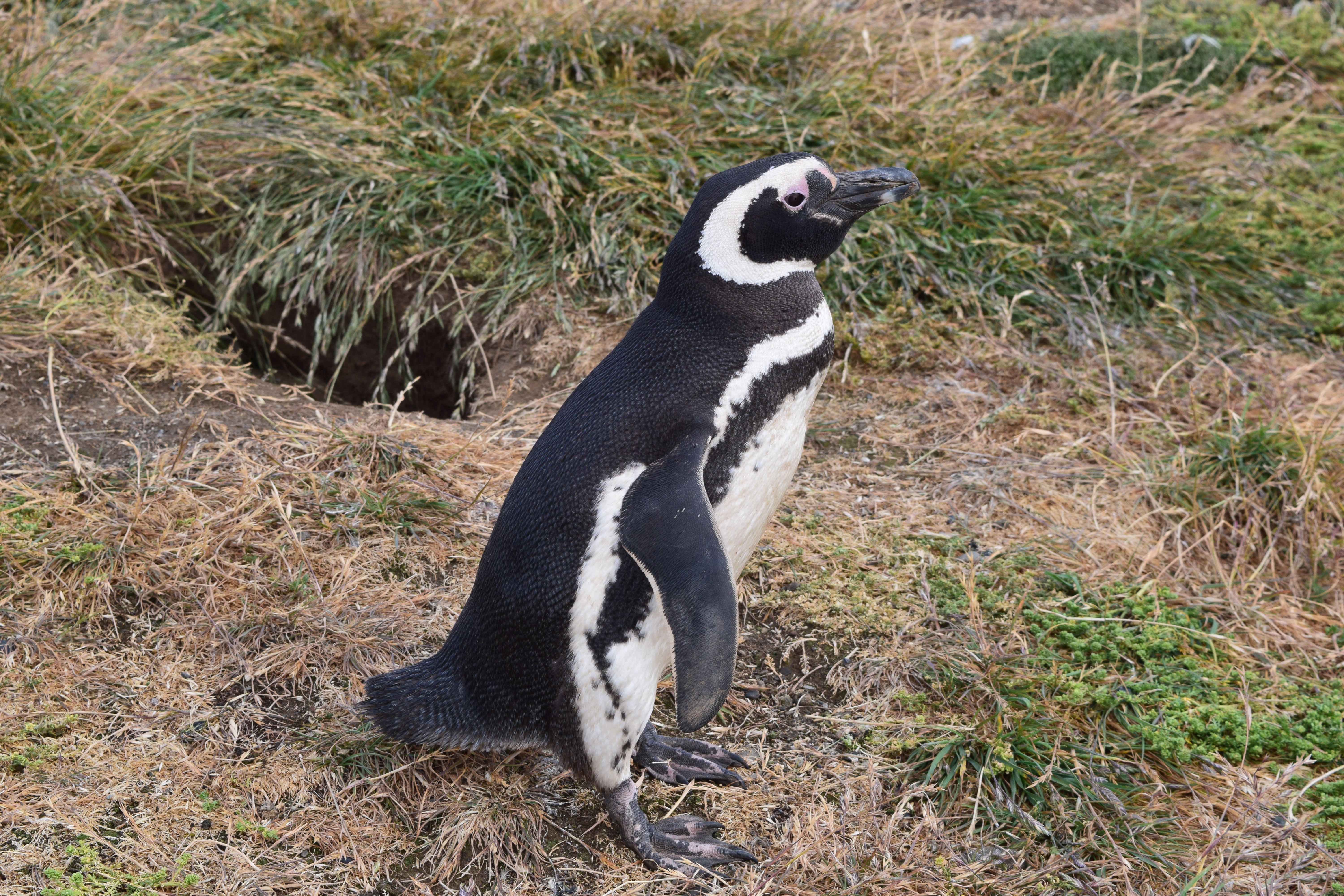
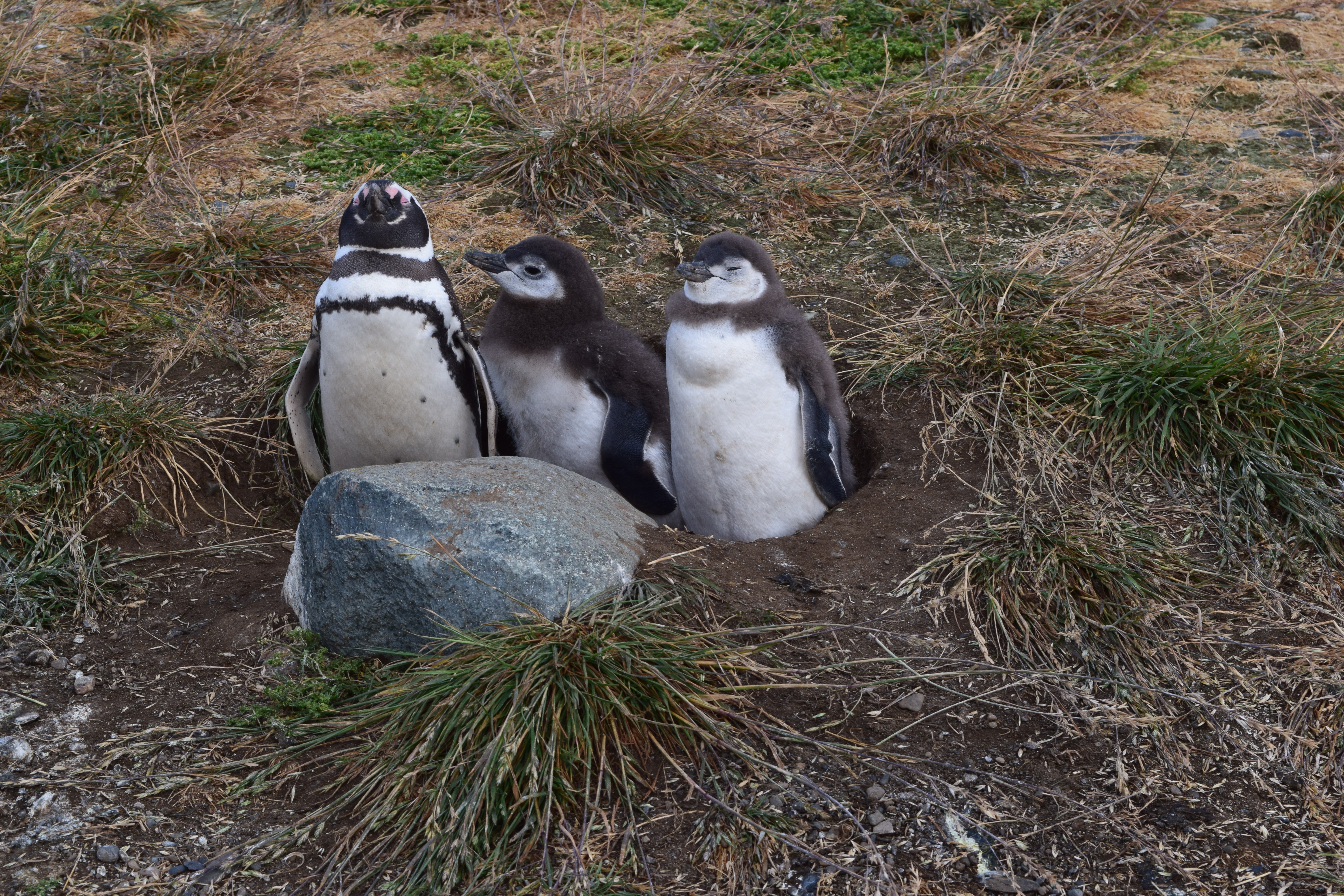
On the morning of Day 8 we took the zodiacs from our ship to visit the penguin colony on Magdalena Island.  It was swarming with very cute penguins and many of their offspring.  Interestingly, there were a lot of seagulls and their chicks there as well, which our naturalists said were relatively recent invaders who are predators for penguins.  We saw a few examples of the cruelty of Mother Nature, but the penguins seemed to be hanging in there so far.

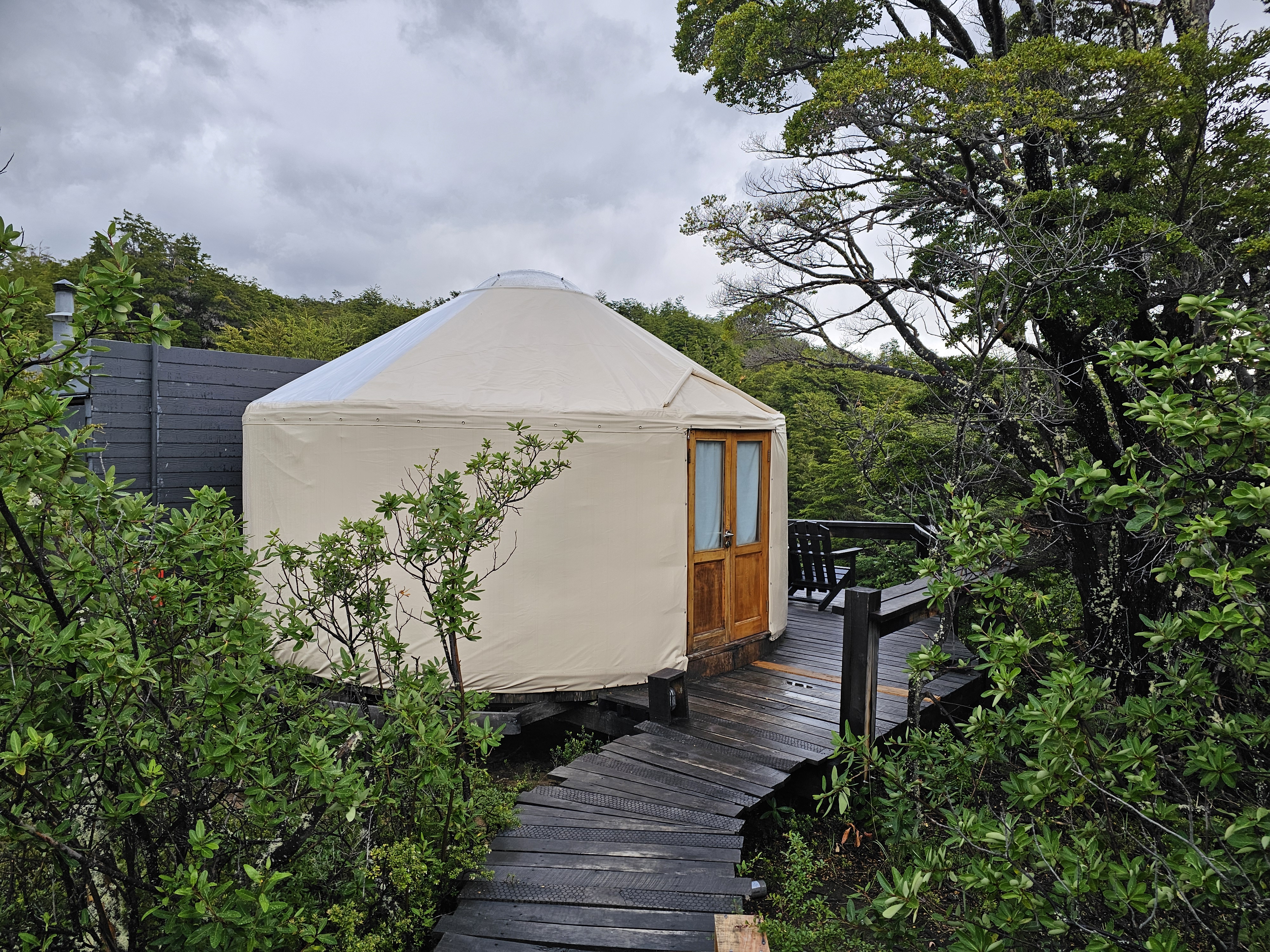
We then disembarked the ship at mid-day in Punte Arenas, which was an important stop on the Straits of Magellan during the California Gold Rush – before the Panama Canal and airplanes were invented to get to San Francisco quicker. After a 4 hour van ride, we arrived at Patagonia Camp for our next 4 days. It is just outside the southern entrance to Chile’s Torres del Paine National Park.  We are staying in yurts, which is a new experience.   More
tomorrow on the yurt experience after the first night………….

On Day 9 our guide told us early in the day that you cannot truly experience Patagonia without the rain and the wind.  We experienced Patagonia today!

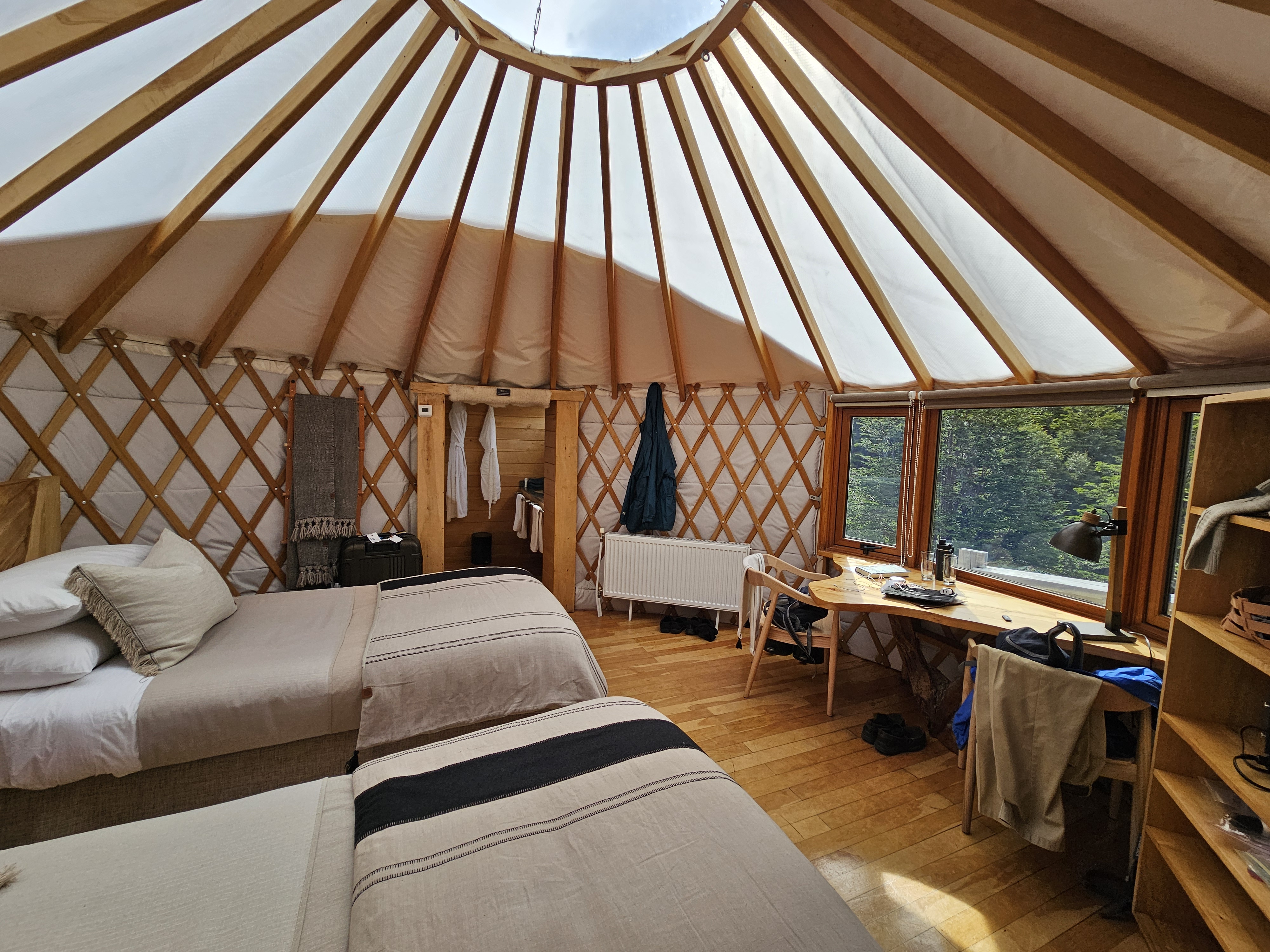
We also spent our first night in our yurt last night.  It is very cozy, but with canvas walls and roof the sounds of the rain and the wind are impressive.  There is also a glass dome at the top which is noticeable when the sun rises at 5 AM.  If one wakes up during the night, the stars are also very bright.  But it was clearly “glamping”, and very comfortable.

On Day 10 our guide Katalina’s quote of the day was:  “You have to enjoy the wind!  That’s Patagonia!” And it really was windy!

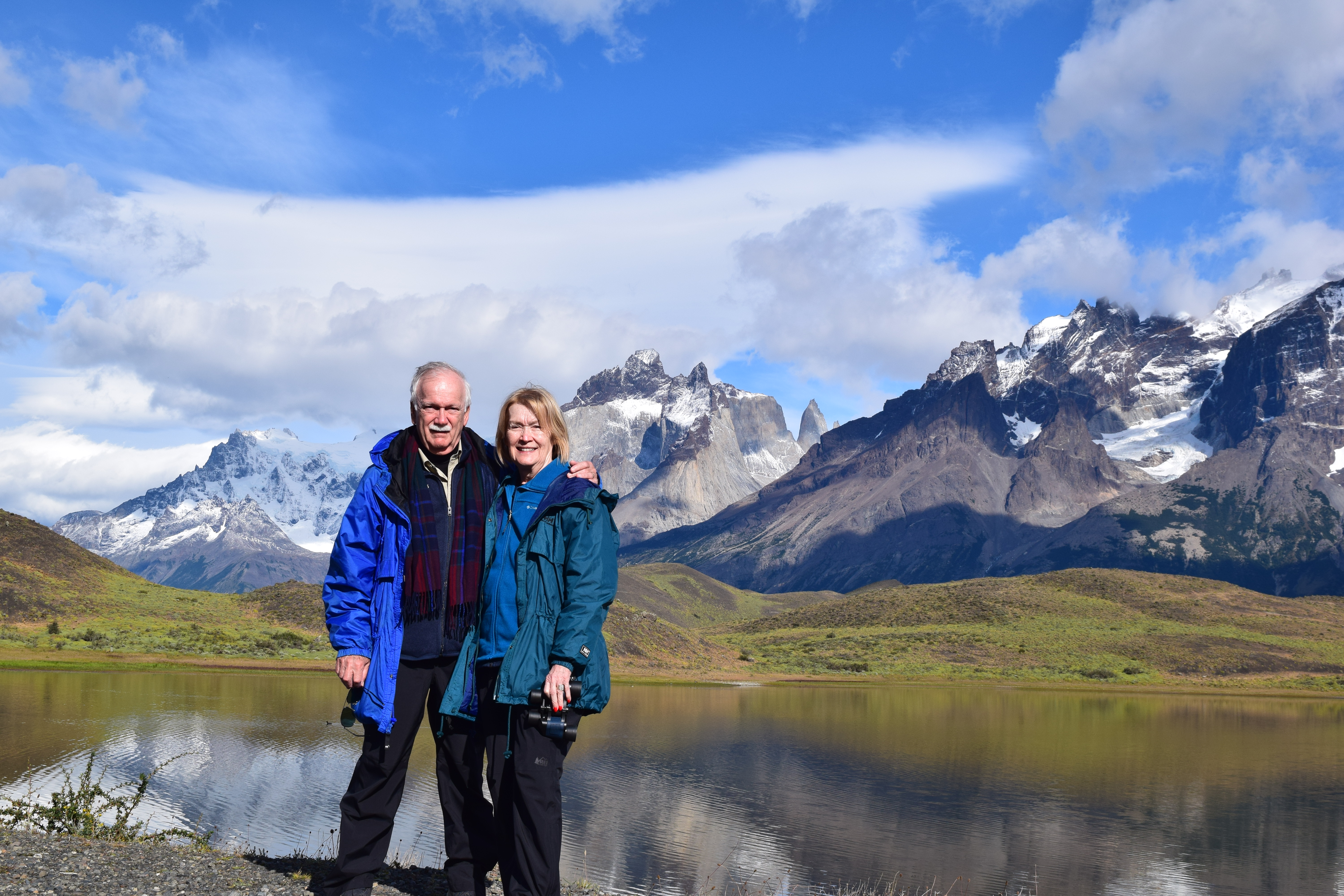
The Torres del Paine National Park is a UNESCO  World Biosphere Reserve.  The skies cleared this morning and we had some spectacular views of the Paine Massif and its key features.

We trekked for 6 miles in the Patagonian Steppes in the eastern part of the park, with a vertical rise of 1000 feet to some caves that had rock paintings that were thought to be made by the native Indians thousands of years ago.  That hike was in an area inhabited by guanacos (llamas) and pumas (mountain lions).  Our guide said it would be very special if we saw a puma and we should stay together if we see one, but they are not normally a threat to humans since they prefer the taste of guanacos.  We did see live guanacos and guanaco bones.

On Day 11 the weather was clear and dry and we took two great hikes.  The first was to Cuernos del Paine (the “horns” of Torres del Paine rock formations).  This trail is known to have the highest winds in the national park and is often closed due to winds over 80 km/hour that make it impossible to stand up.  Our guide Katalina told us we were very lucky that the winds were only 55-60 km/hour today.  That still seemed plenty windy.  But the hike was great.  We viewed the “Horns” and “Big Paine” from several angles.

The second hike was another nice one, to see the thrombolites in Lake Sarmiento.  These are one of the earliest forms of life when there was only algae around about 100 million years ago.  They can only be found in a few places around the world, mostly in the Southern Hemisphere.  The only place in the US is Green Lakes State Park near Syracuse New York!

According to my watch, we covered 23,732 steps, 10.15 miles and 65 floors of elevation gain today.  This was our last day of the expedition.  The next day we headed to Santiago, Chile to catch our flight back to Orlando the following day.

Egypt 2024

In November we spent two weeks in Egypt coordinating the annual 50 Hz. Users’ Conference. We had last been there in February/March 2020 and had contracted Covid on the Nile River. It worked out better this time.

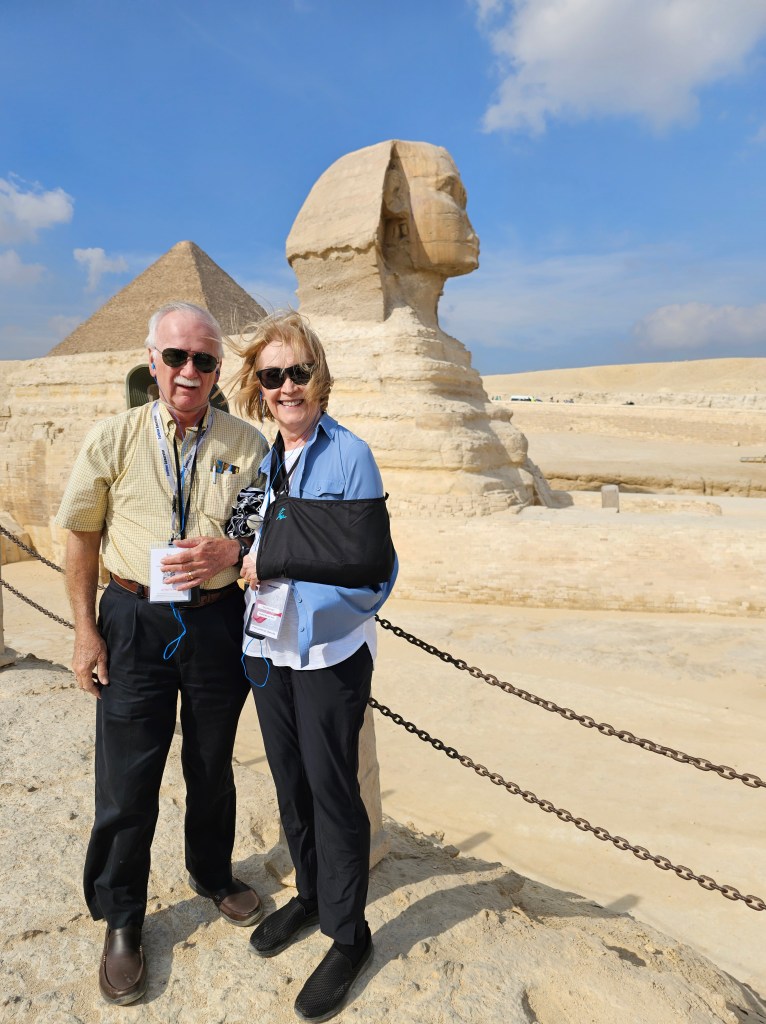
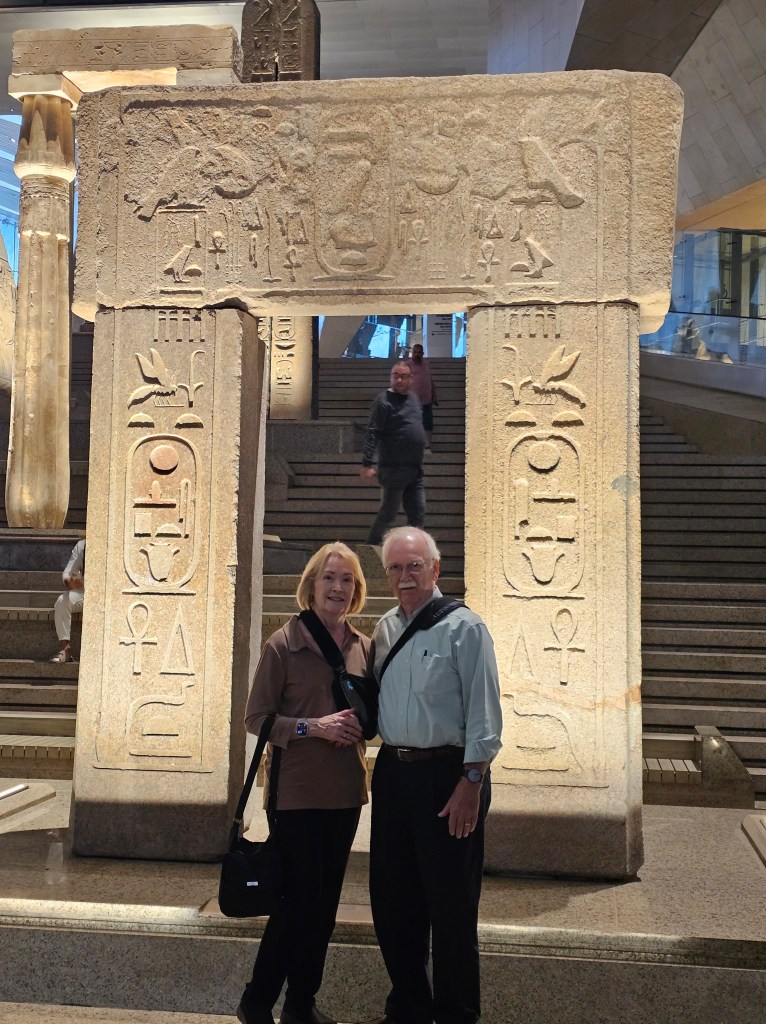
In addition to the Conference itself, we had the opportunity to visit the Pyramid Plateau, the Sphinx and the soft opening of the new Grand Egyptian Museum in Giza, the largest archeological museum in the World.

Peruvian Upper Amazon 2024

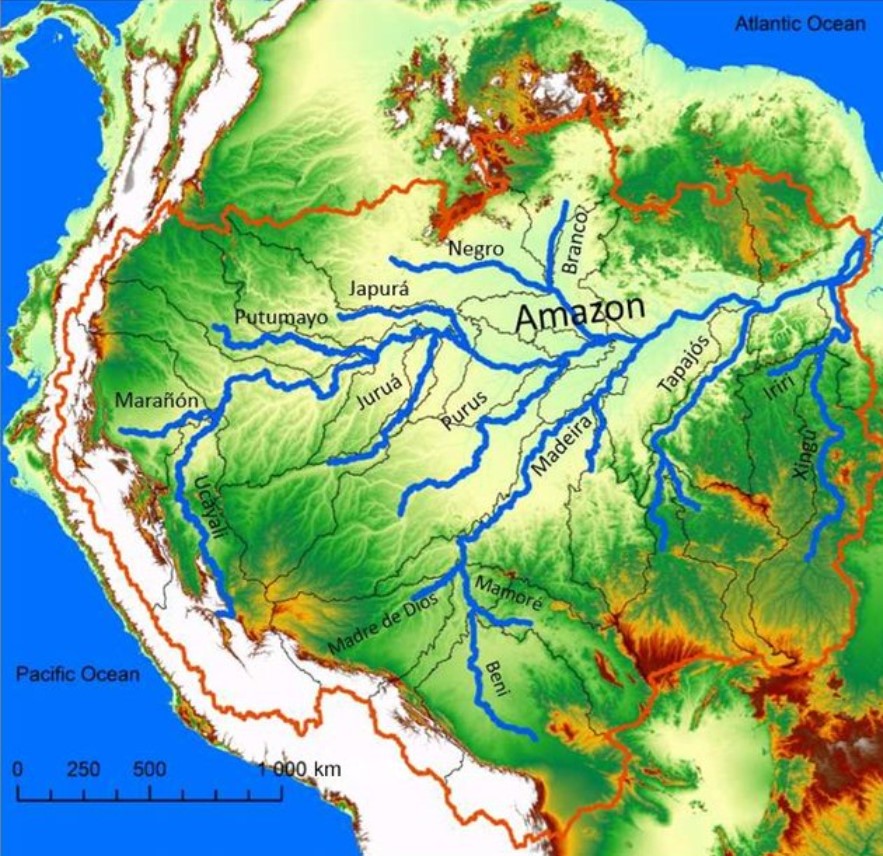
In late August and early September we journeyed with our friends Peg and Roger to South America. This was an “Expedition, not a Tour” organized by Lindblad Expeditions and National Geographic to the Upper Amazon region of Peru.  We explored two of the major tributaries of the Amazon, the Ucayali and the Maranon, which arise in the Andes Mountains of Peru and come together at Nauta, Peru to form the Amazon.  The Amazon proceeds from there for another 3000 miles through parts of Peru, Columbia and Brazil before emptying into the Atlantic.  It delivers 30% of all of the fresh water in the world.  It is considered the longest river on the planet at 4345 miles in length, allegedly longer than the Nile by 87 miles (but other trips to Egypt found folks there who disputed that).

August 31, 2024: LIMA, Peru

We began the expedition in Lima, Peru, where we visited Plaza de Armas and surroundings in the heart of colonial Lima.   In 1988, UNESCO declared the historic center of Lima a World Heritage site for its high concentration of historic buildings constructed during the Spanish colonial era.  Ornate facades line centuries-old streets, adorned with more than 1600 intricate balconies, plus palaces and cathedrals begun in 1535 under Francisco Pizarro.

We stayed at the Country Club Hotel in fashionable San Isidro and visited Huaca Pucllana, an adobe pyramid built by the pre-Inca Lima Culture in 200-700 AD and now one of several pyramids surrounded by the city of Lima.

Pyramid remains in background, made of millions of bricks stacked vertically

September 1, 2024: LIMA to Iquitos to Nauta

The next day we flew 1.5 hours over the Andes Mountains from Lima to Iquitos, Peru, a city of 500,000 that is only accessible by air or river.  Only one road leads out of the city, going about 50 miles to Nauta where we boarded our ship, the Delfin II.  Iquitos was the center of the Peruvian “rubber rush” in the late 19th Century and early 20th Century when rich rubber-barons built lavish mansions, opera houses, etc. in the grand European style.

Taking a skiff to our expedition ship

Adriatic Treasures – Croatia to Venice 2024

In May we travelled to the countries along the coast of the Adriatic Sea. It was a great trip.  We were in 6 European countries, four of which were new for Paula and three of which were new for John.  We made a total of eleven (11) border crossings, so the passports got a lot of use.

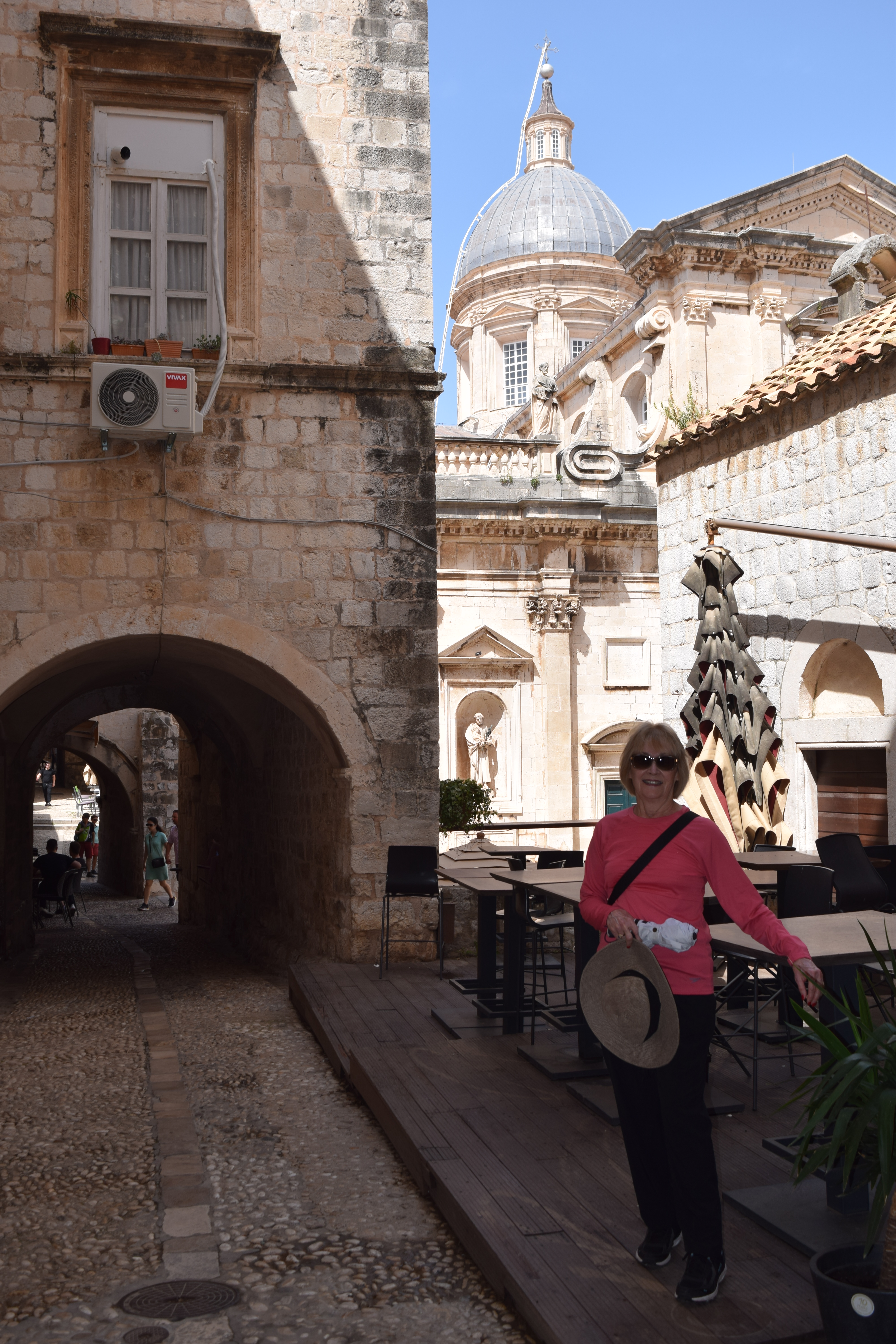
On Day 1 we arrived in Dubrovnik, Croatia and spent our first three days there and in the surrounding area.  Dubrovnik is on the Adriatic Sea, with an Old City surrounded by walls begun in the 10th Century.  Croatia is one of several countries we visited on the Balkan Peninsula, all of which were part of the former Yugoslavia that broke up around 1990.  They were at war with each other in various combinations over the next five years due to nationalism and ethnic rivalries.  This, along with thousands of years of history as part of many different empires ranging from Greece, Rome, Venice, Ottoman Turkish, Austro-Hungarian, Soviet Union and others meant lots of history to learn about, both old and recent.

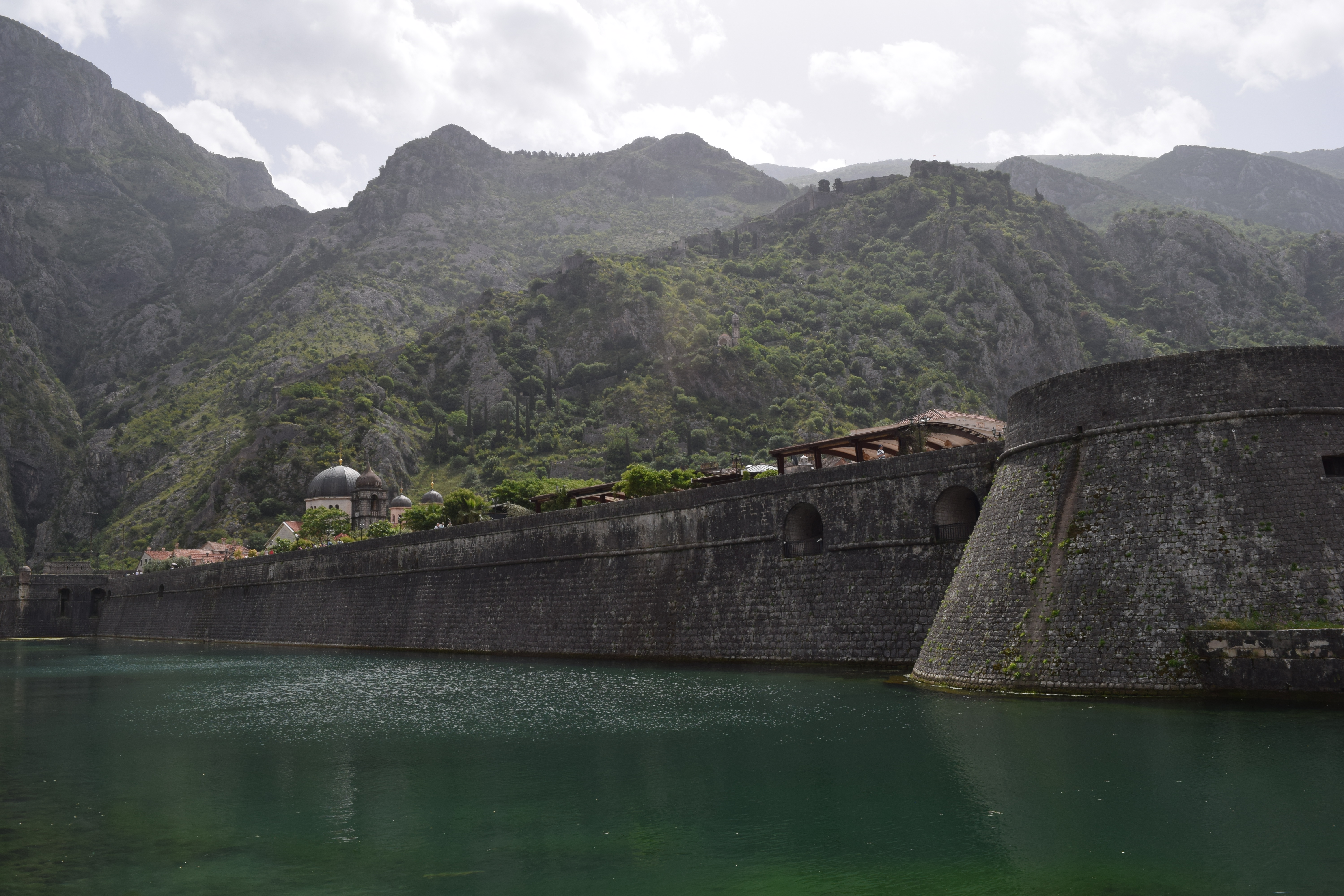
On Day 4 we travelled from Dubrovnik, Croatia to Montenegro, which is only 25 miles away. In the early 1990’s the countries were at war and Montenegro, along with Serbia, was bombarding and blockading Dubrovnik.  Things have calmed down since then and the city of Kotar in Montenegro was beautiful.

On Day 5 we travelled into Bosnia and Herzegovina, a majority Muslim country with many Ottoman influences.  We visited the city of Mostar which still has many heavily damaged buildings and tragic memories from the war with Serbia in the 1990’s.

In front of Stari Most Bridge, built by the Ottomans in 1557, destroyed in 1993 war and rebuilt

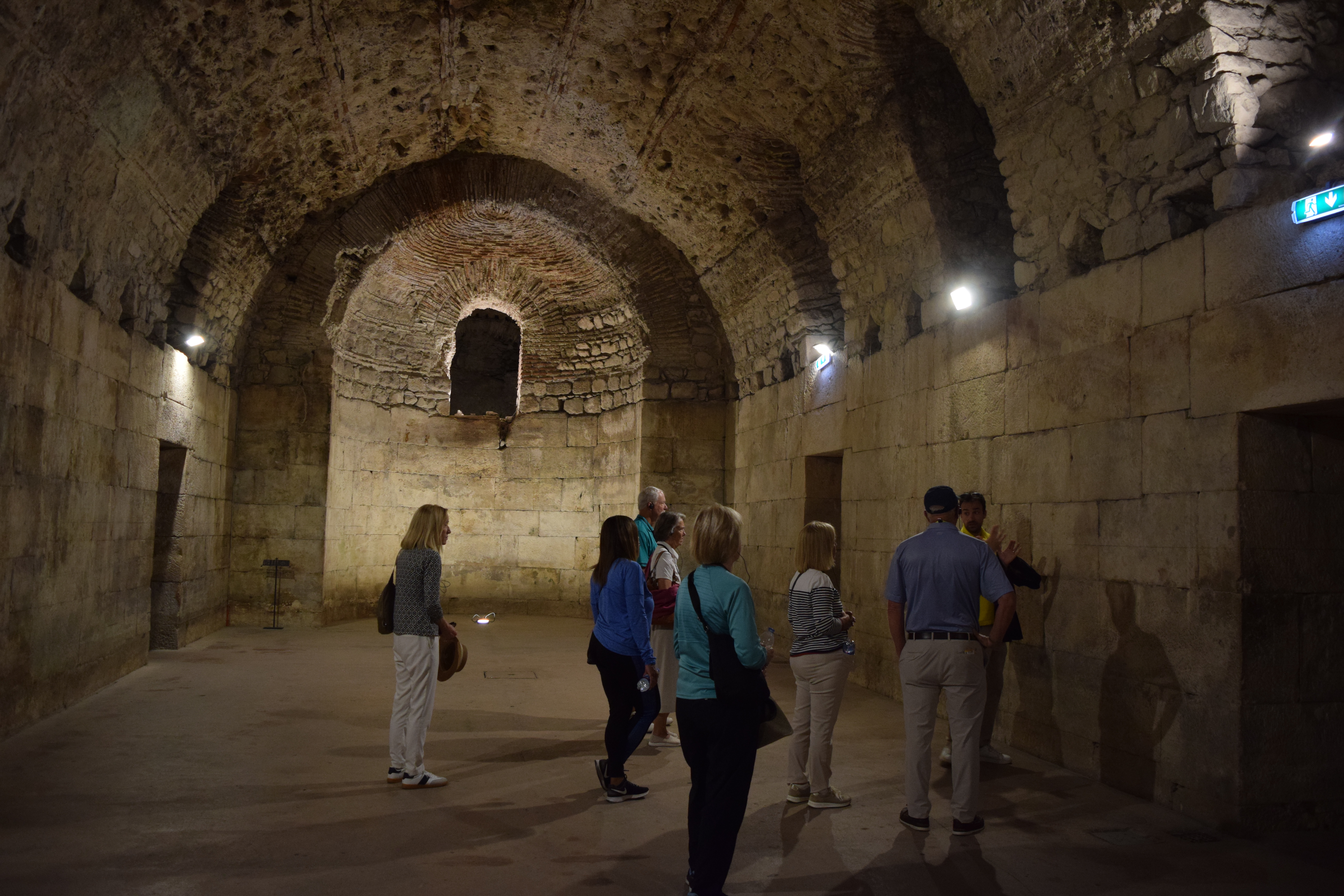
On Day 6 we were back on the Adriatic coast in Split, which was where Roman emperor Diocletian built his retirement palace with the help of 6000 Egyptian slaves in 300 AD.  It is the most well-preserved Roman structure we have ever seen.

On Day 7 we went to the Croatian national park Krka, had dinner in Roca at the House of Dalmatian Smoked Ham and then flew to Zagreb in the evening. On Day 8 we toured Zagreb, the capital of Croatia and had a meeting with the former Minister of Tourism of Croatia to learn about her experiences during the Communist years and how she helped restore tourism after the war in the 1990’s.

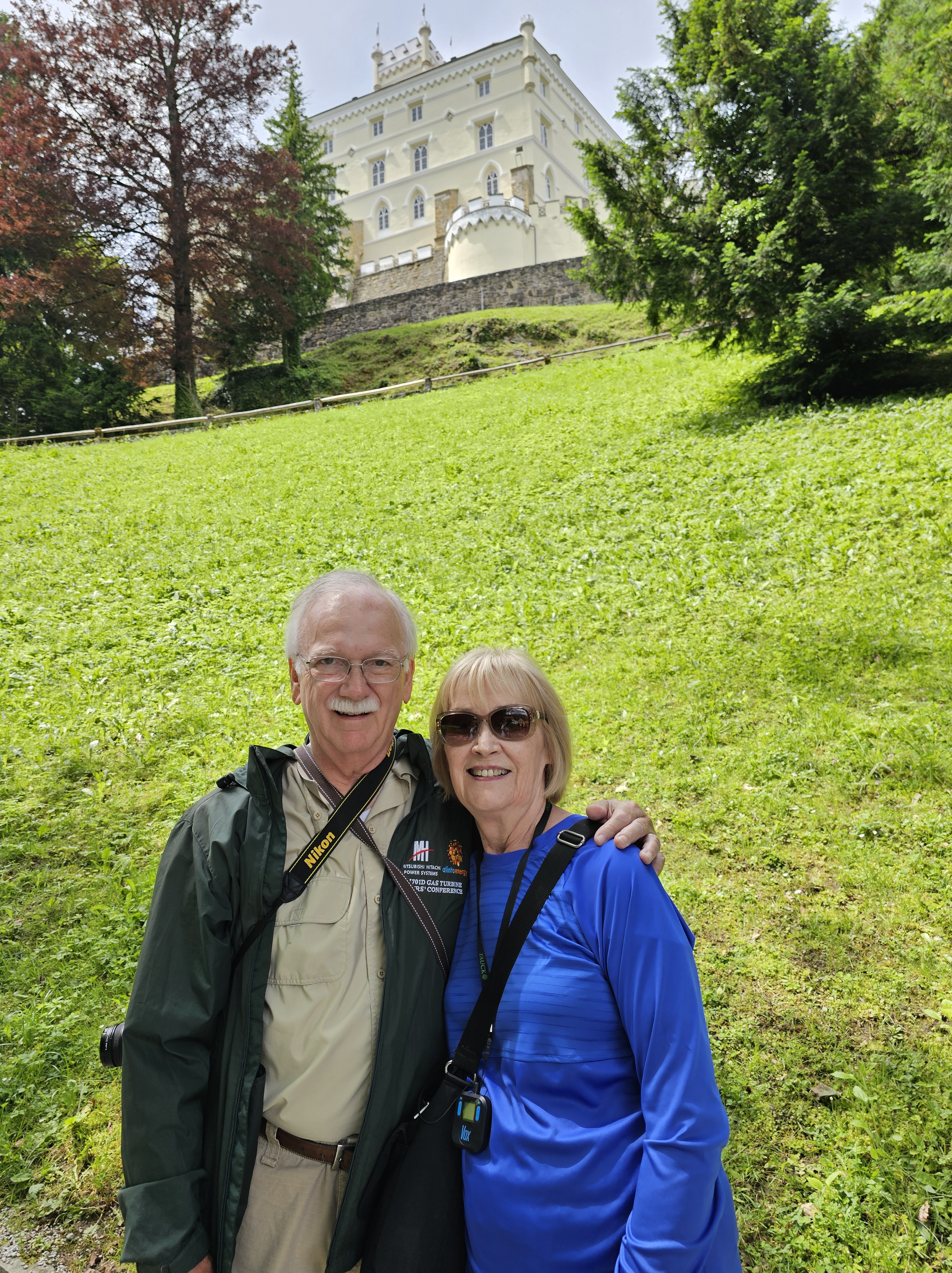
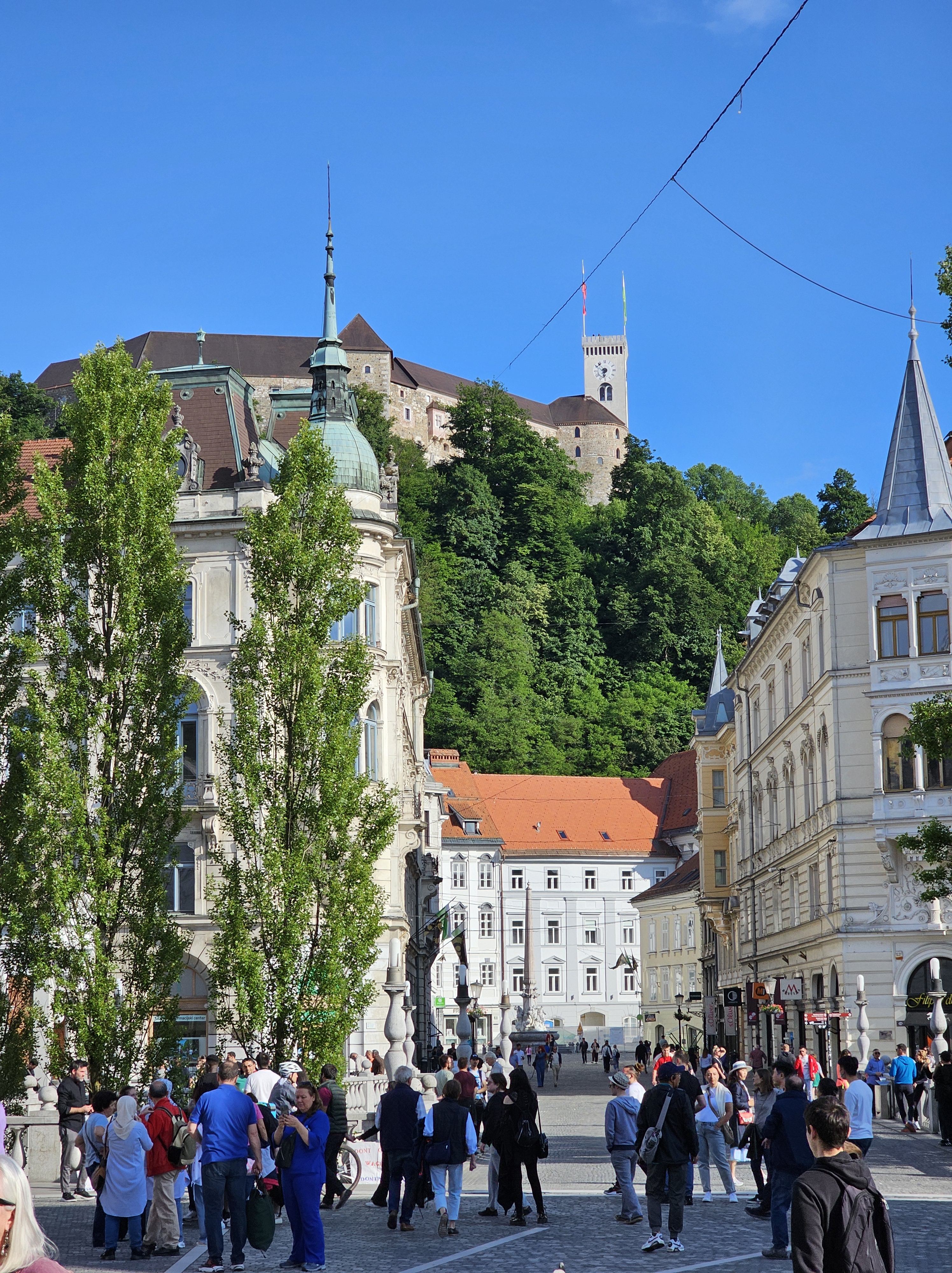
On Day 9 we visited Trakoscan Castle, one of the best preserved castles in Europe, and travelled across the border to Ljublana, the capital of Slovenia. John was last in Ljubljana in 1978 on a business trip.  It has changed a lot from the Communist times….. On Day 10 we toured Ljubljana and drove to the nearby Slovenian Alps for lunch, a gingerbread demonstration in Radovljica and a visit to nearby Bled Castle.

On Day 11 we left Ljubljana and toured the spectacular Postojna Caves. After that we went to the family-run Prodan truffle farm to learn all about truffles, meet the truffle-hunting dogs and have a truffle-laden lunch

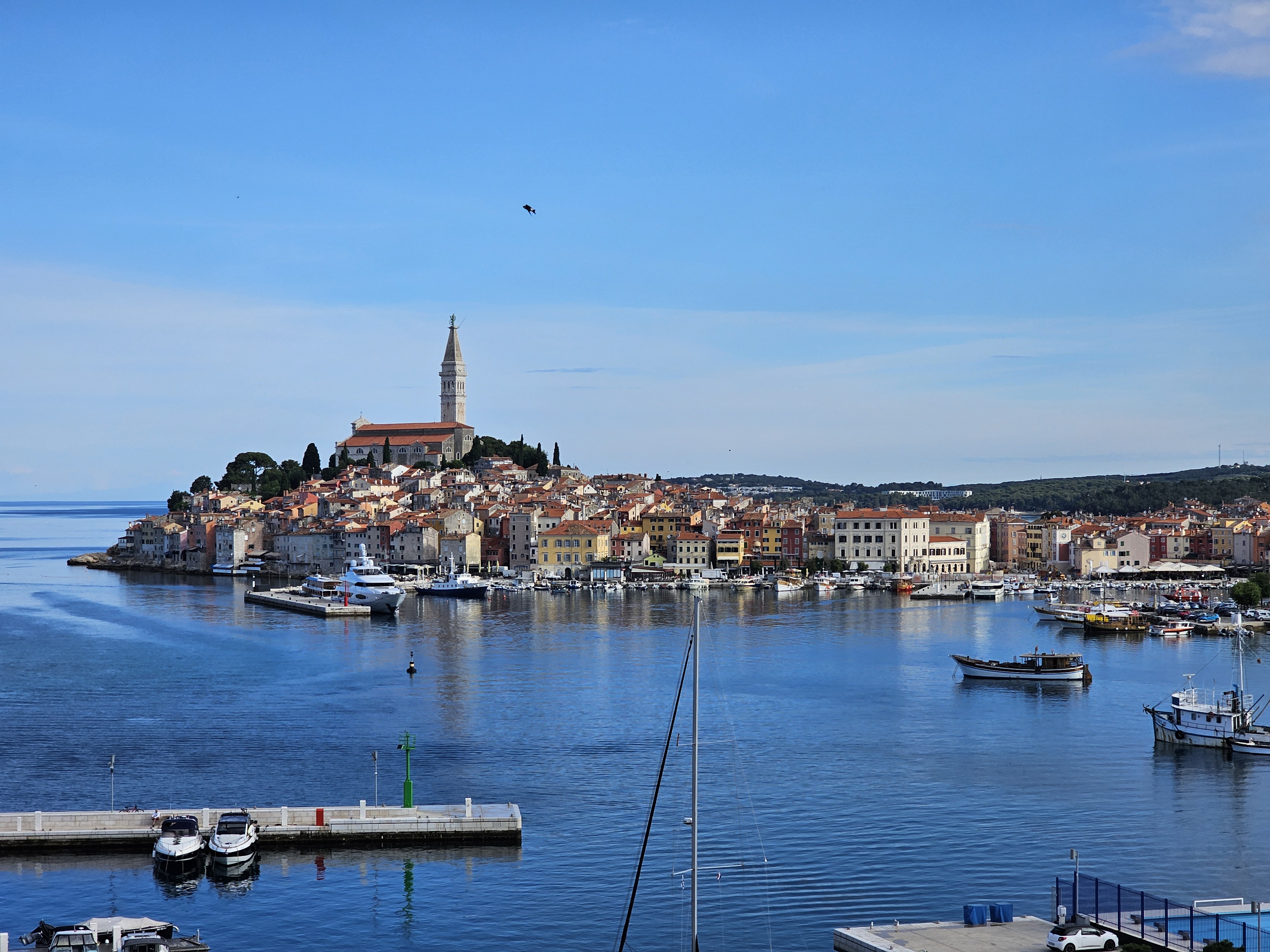
That evening we arrived in the lovely seaside town of Rovinj to spend the next two nights.

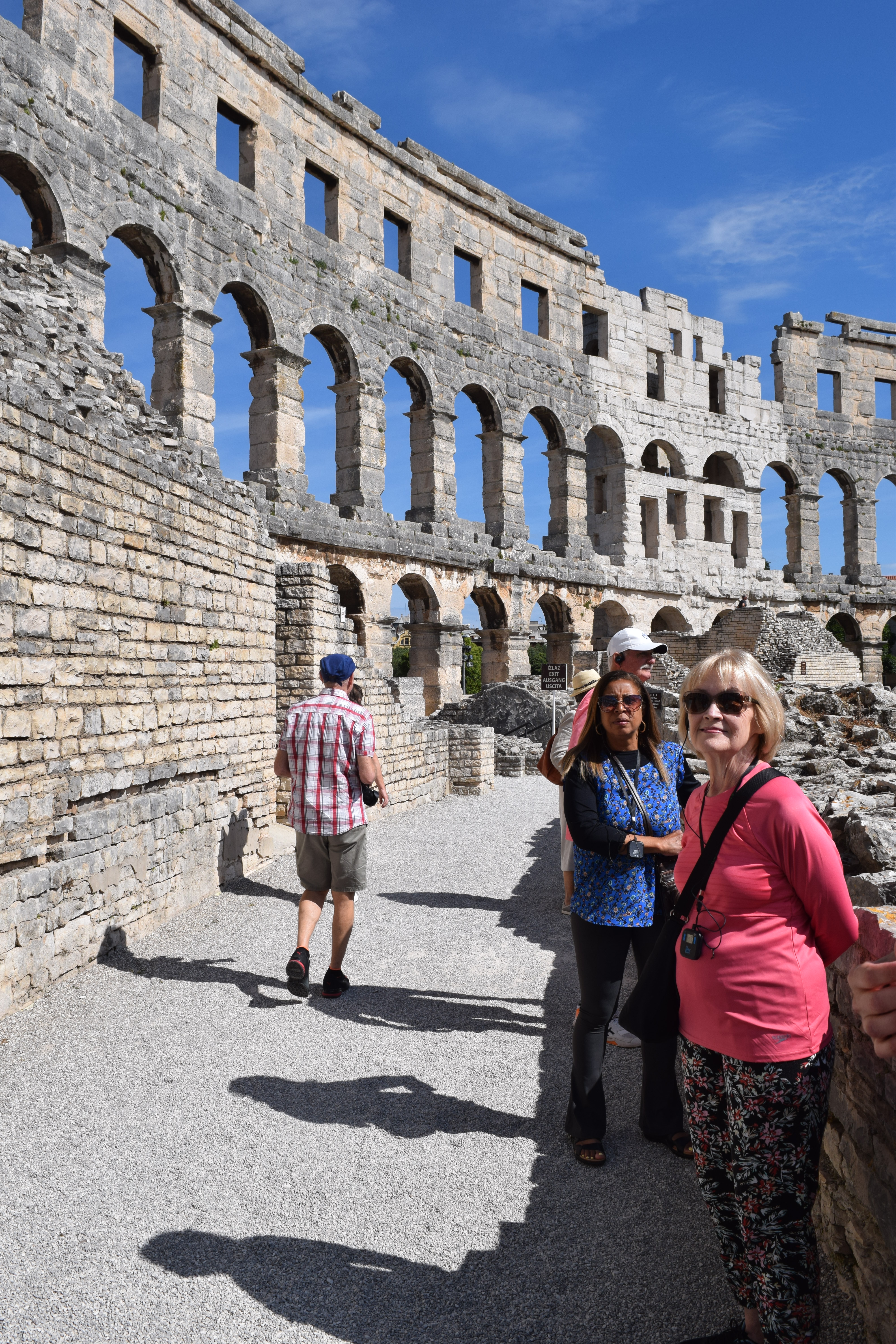
On Day 12 we toured the well-preserved 2000 year old Pula amphitheater which was the prototype for the Coliseum in Rome.  Dinner was at an old fisherman’s tavern in the old town of Rovinj.

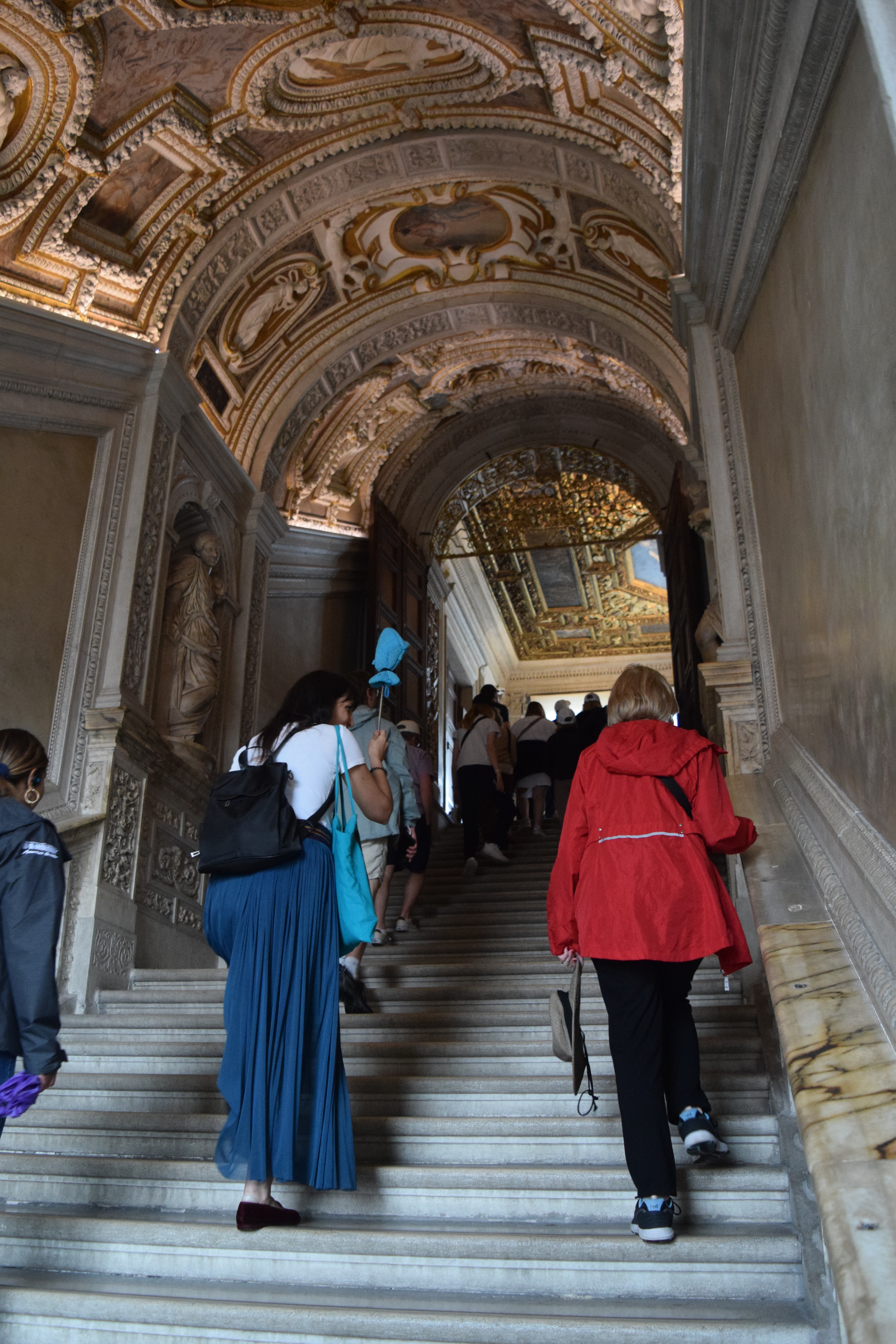
On Day 13 we entered Italy from Croatia and arrived in Venice.  Venice was a relatively independent Christian republic for 1000 years from the 8th to the 18th Centuries, nominally connected for most of that time to the Byzantine Empire in Constantinople (Istanbul) after the fall of the Roman Empire.  We visited the Doge’s Palace and, as recommended, got lost walking around the city.  The old part of Venice basically has no surface roads and transportation is all by boat or by walking.  It is built on 118 islands in the lagoon and has 400 bridges.  We stayed in the Hotel Metropole, a building dating from about 1300 which has been a hotel for over 500 years.  It was also the location of Antonio Vivaldi’s oratorio where he taught music and wrote many of his masterpieces in the early 1600’s.

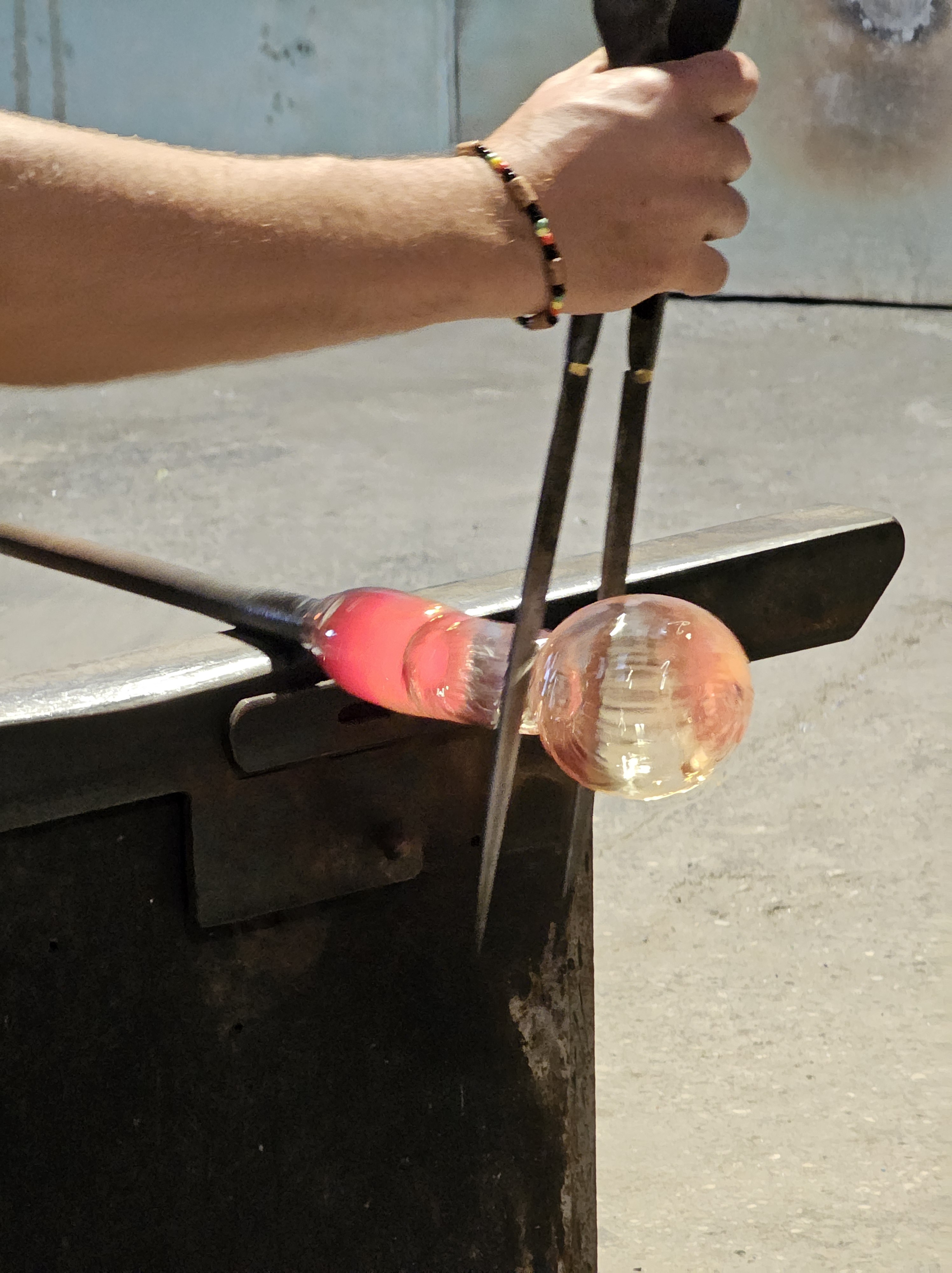
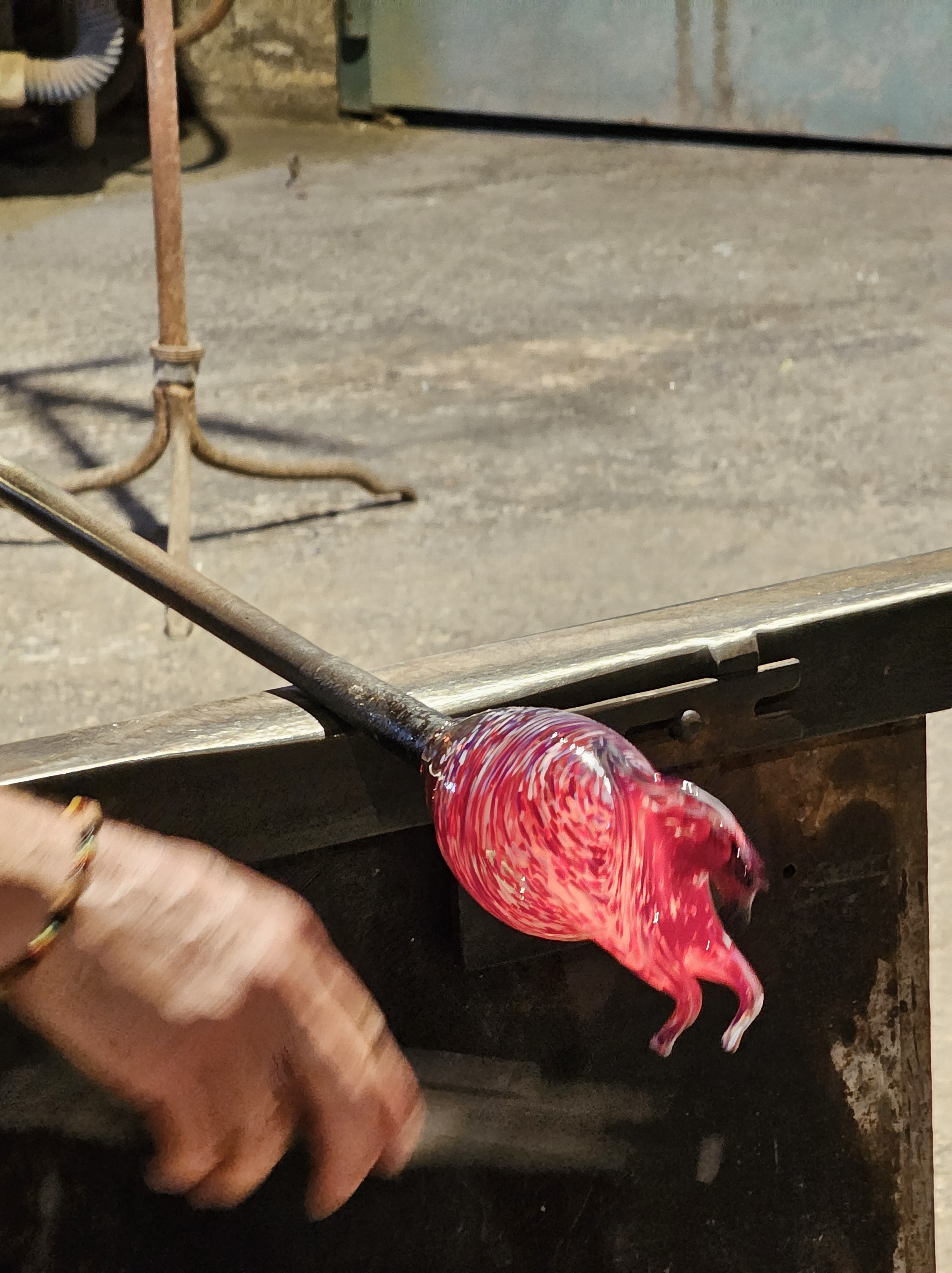
The next day we travelled by water taxi to two nearby islands.  Murano is the center of the famous Venetian glass-making industry, moved there at the Doge’s order in 1291 to get the furnaces away from the mostly wooden buildings on the main islands.  We had an amazing demonstration of the glass-making process and saw some spectacular glass products.  The second island was Burano, center of the Venetian lace-making industry.  Both were less crowded with tourists than the central islands.

Tahiti and the Tuamoto Islands 2024

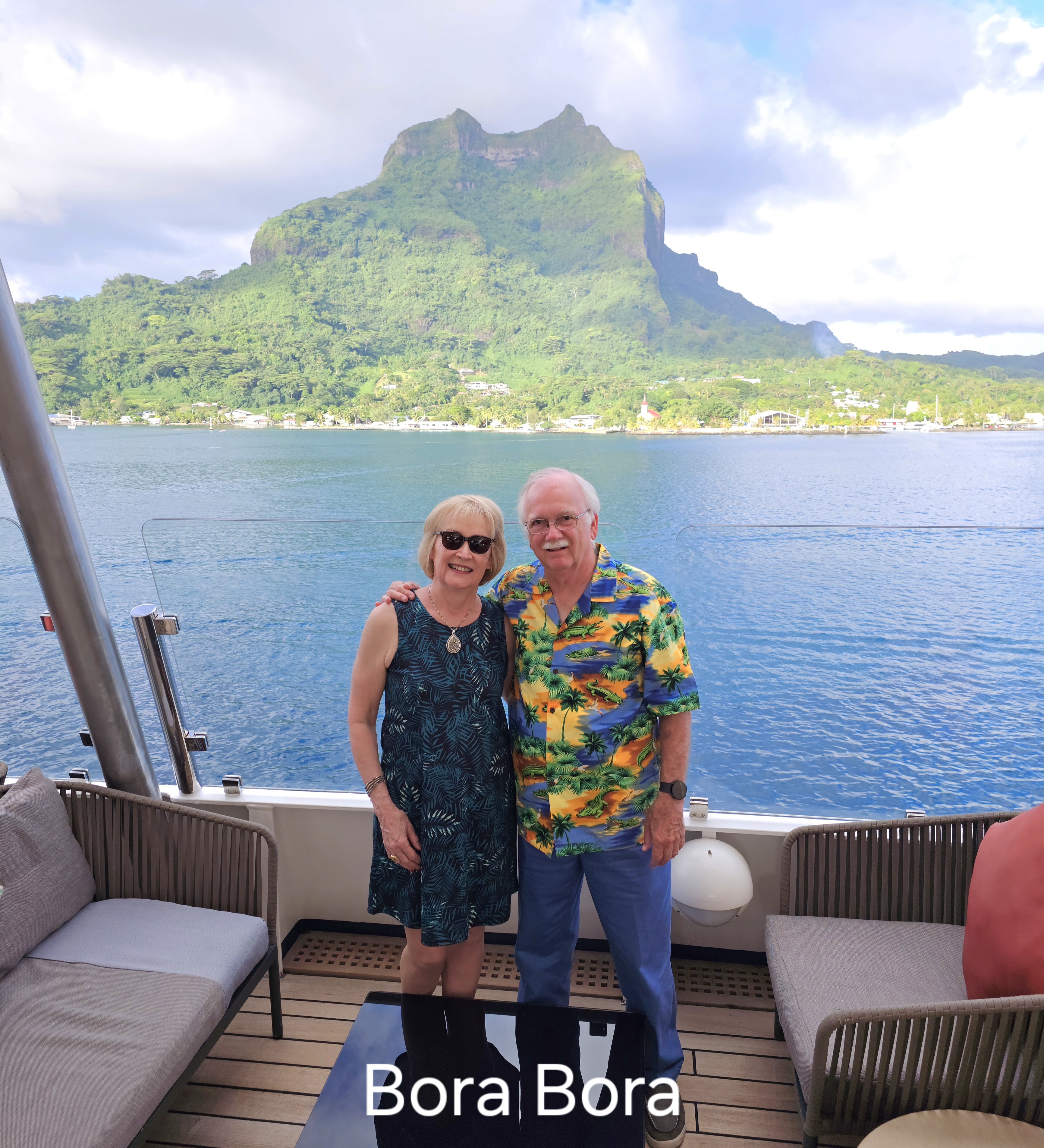
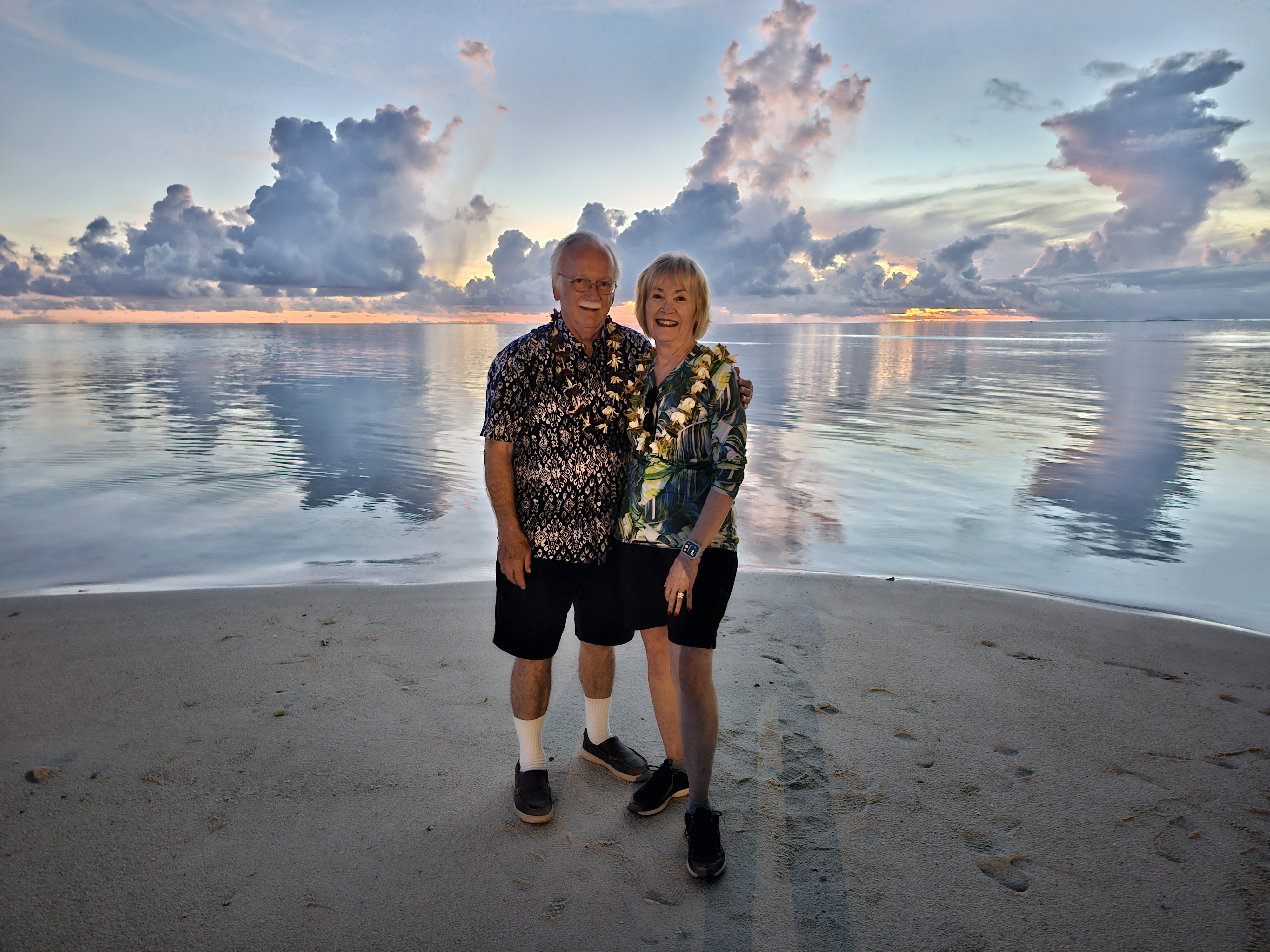
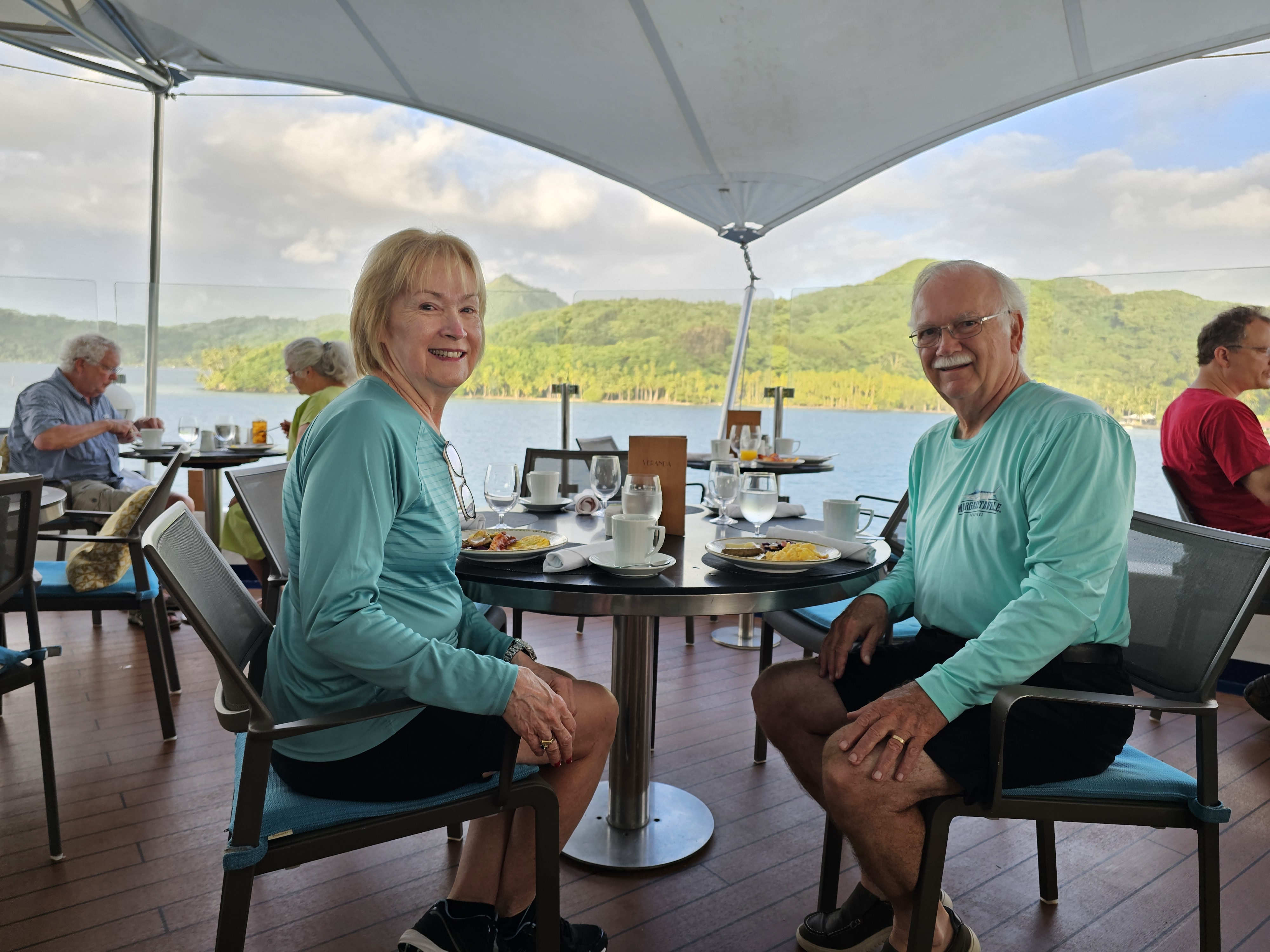
In March and early April we travelled to French Polynesia for a small-ship cruise to 8 islands in the South Pacific

We started out in Papeete on the island of Tahiti and did quite a bit of walking the first two days.  After confirming that they speak French there, we tried to get recalibrated to French.  First immediate affirmative reaction to a question was “si”.  Second was “hai”.  “Oui” came out third, so we had to work on that. We boarded the Sea Breeze in the afternoon of the second day and set sail at 6 PM as the sun was setting.

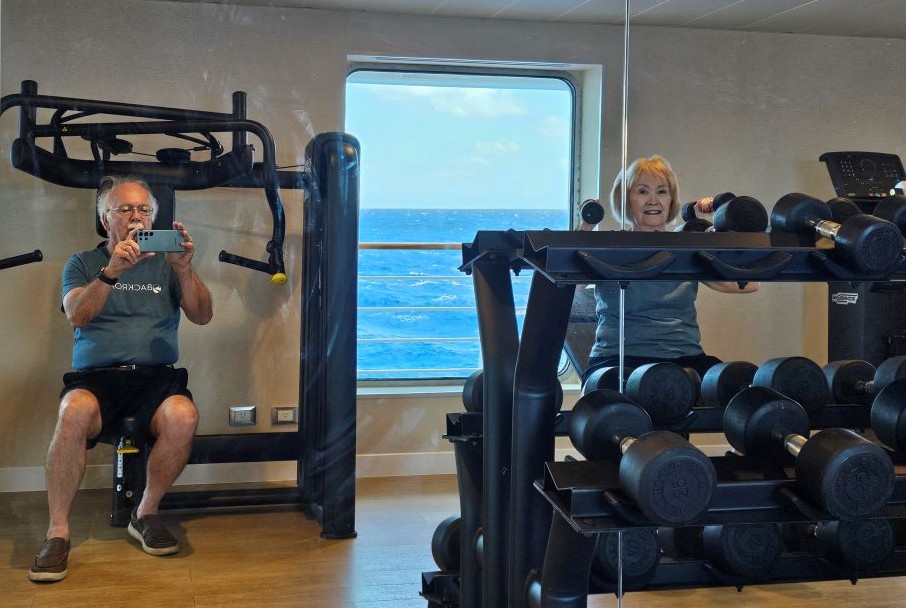
Day 3 was at sea all day.  It took about 30 hours of sailing to get to our first destination, the Fakarava atoll.  The sea was fairly rough, so walking was a little wobbly.  The planned 1 mile power walk around the top deck was cancelled because the deck kept moving.  Wanting to get at least some token exercise, we used the gym.

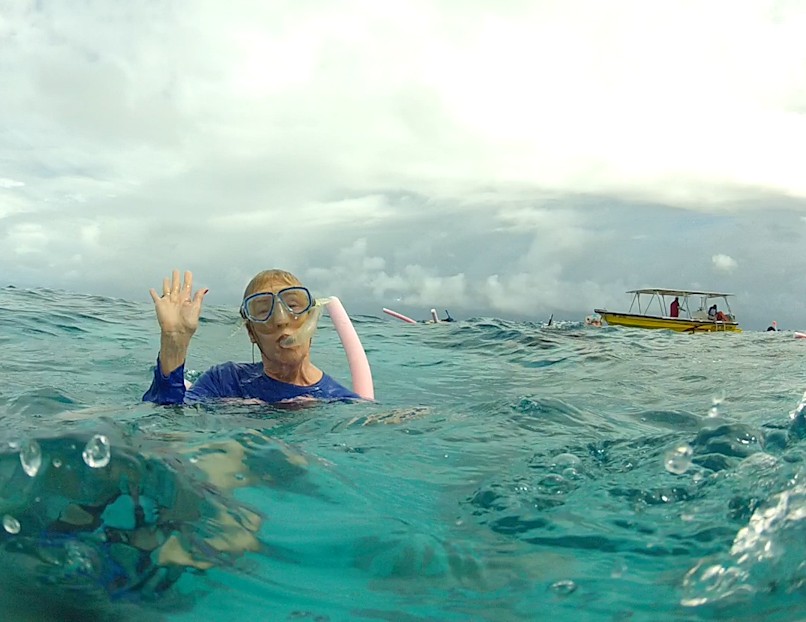
Starting to get the relaxed vibe of the islands, we stopped at Fakarava Atoll and Rangiroa Atoll.  Both are classic examples of an older atoll, where the formational volcano has completely collapsed back into the sea and all that remains is a ring of coral reef with a few palm trees, a few people and a big interior lagoon, often several hundred square miles in extent.  Both days we anchored inside the atoll, so the water was relatively calm and good for snorkeling.  John snorkeled three times, one a drift dive in the open ocean outside the entrance pass, and Paula two times in the lagoons.

We snorkeled almost every day and were amazed every time at what was under the surface of the water.

Lots of good experiences:

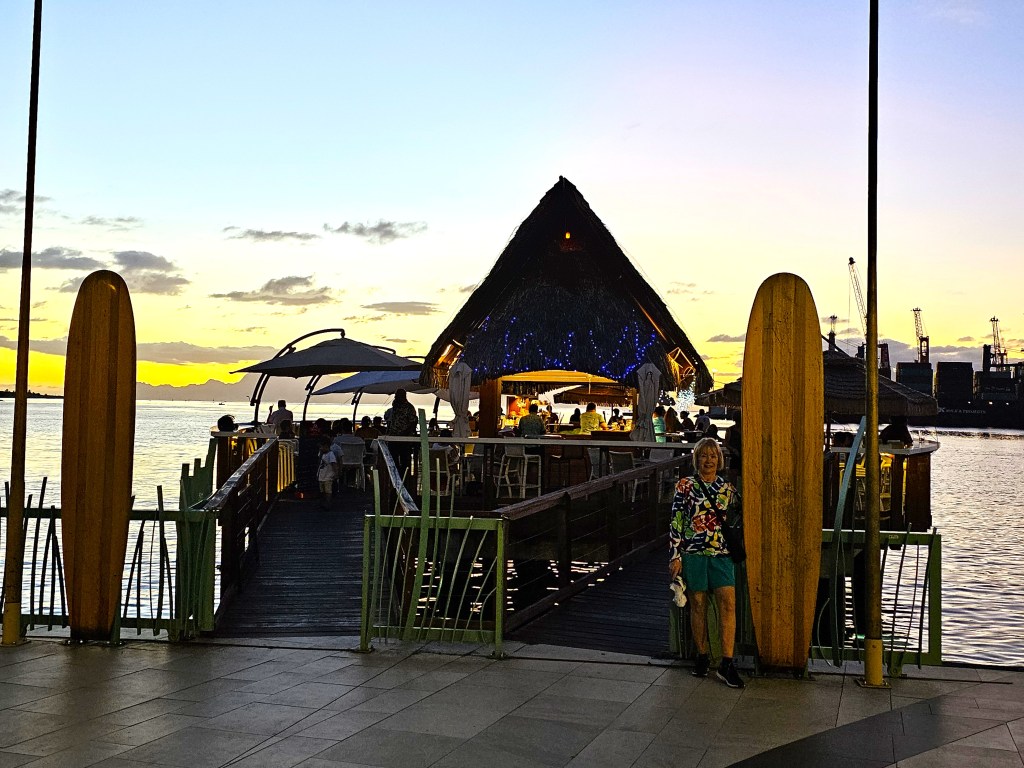
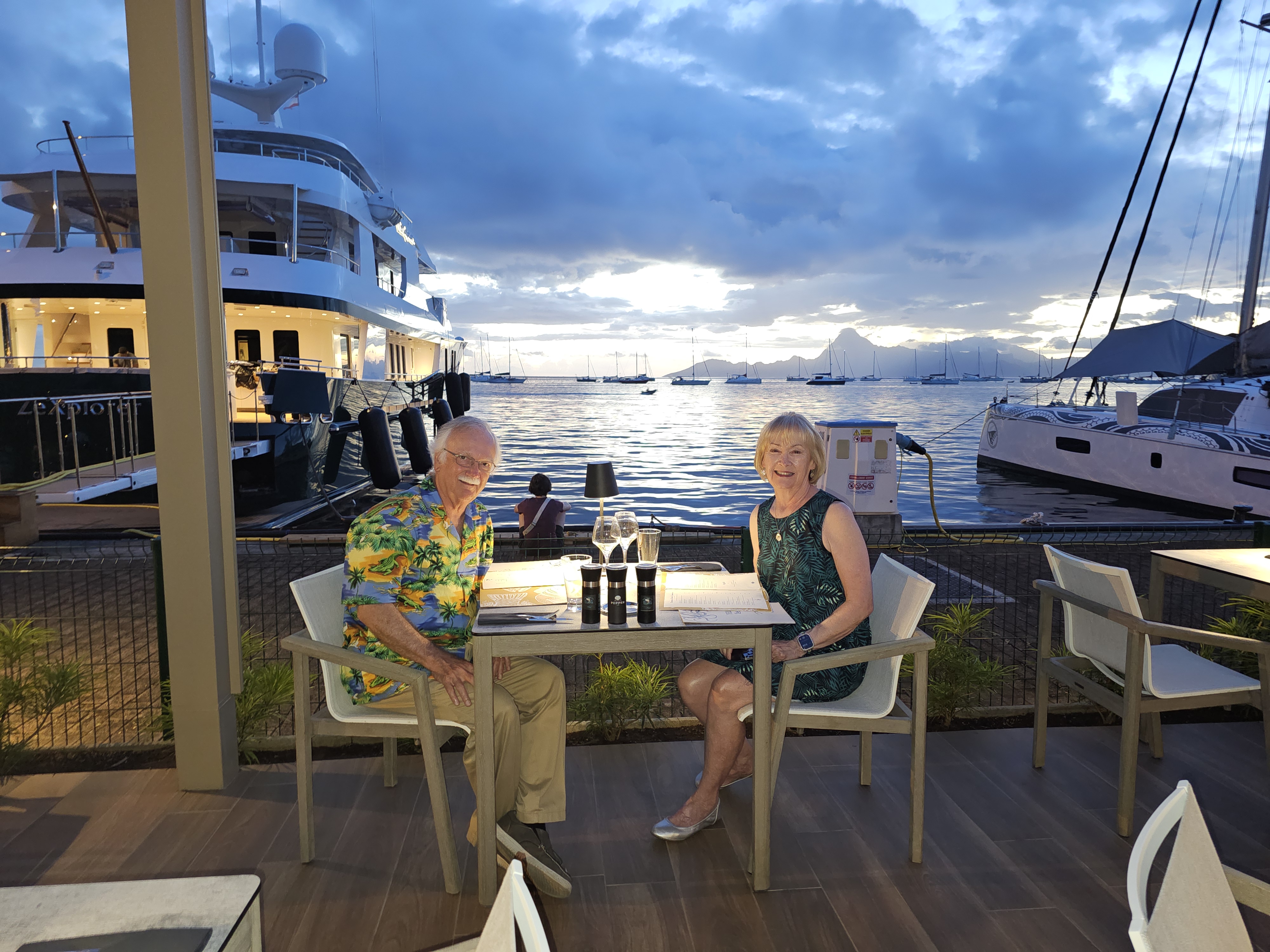
After 11 days we disembarked our yacht the Sea Breeze back in Papeete.  We stayed in Tahiti two more days waiting for a suitable plane connection home.  Paula found an Air BnB that is a cute little bungalow on the water, close to the airport but hidden behind a McDonalds and a Mobil Station.  Took us a while to figure out how to get in.  It had a covered dock that we sat on, using our devices and gazing out at sailboats and Moorea, the next island to the west that we had visited the day before. We found a nearby marina restaurant that had the same view.

We returned home after two weeks. A trip we would heartily recommend.

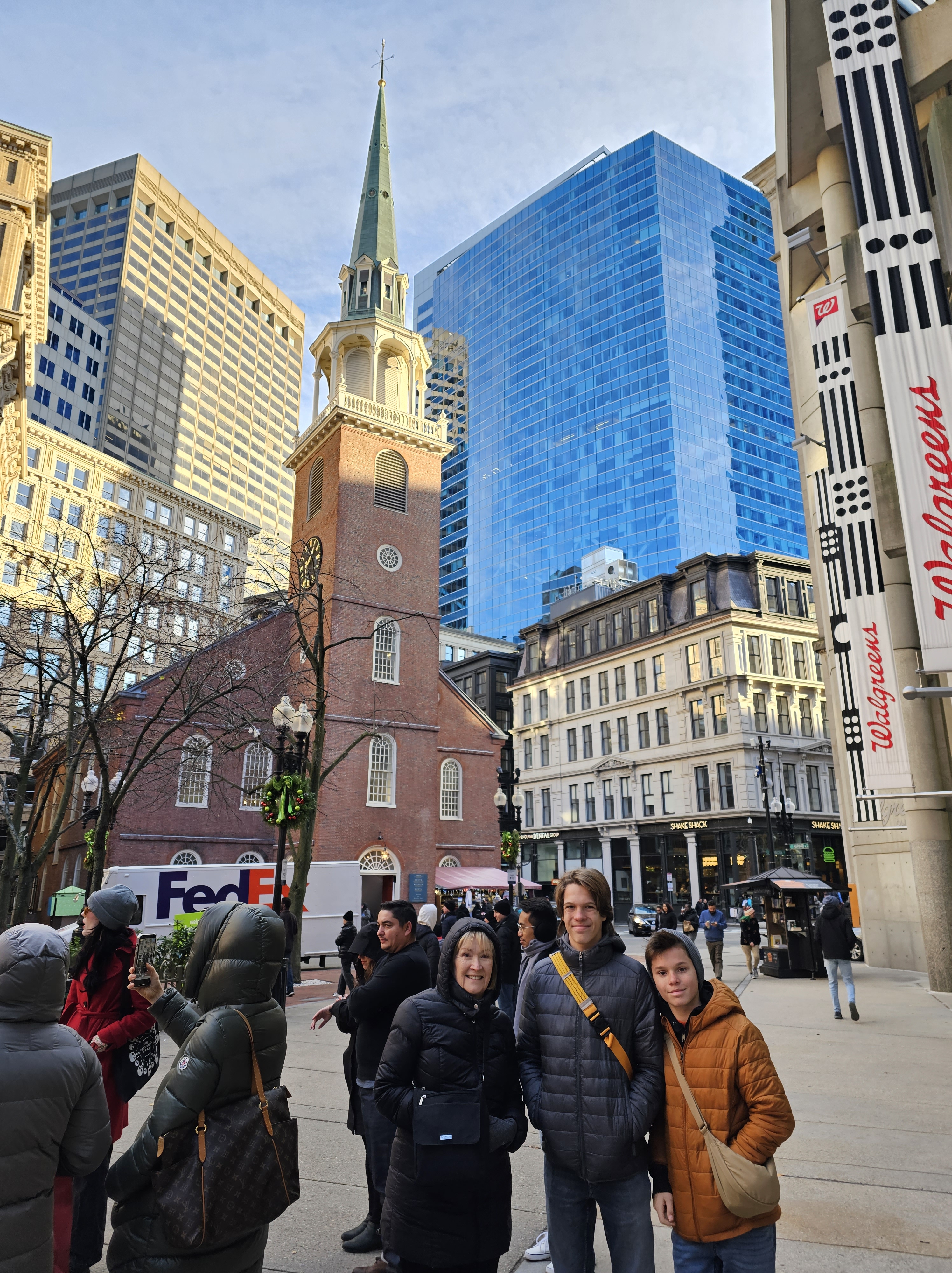
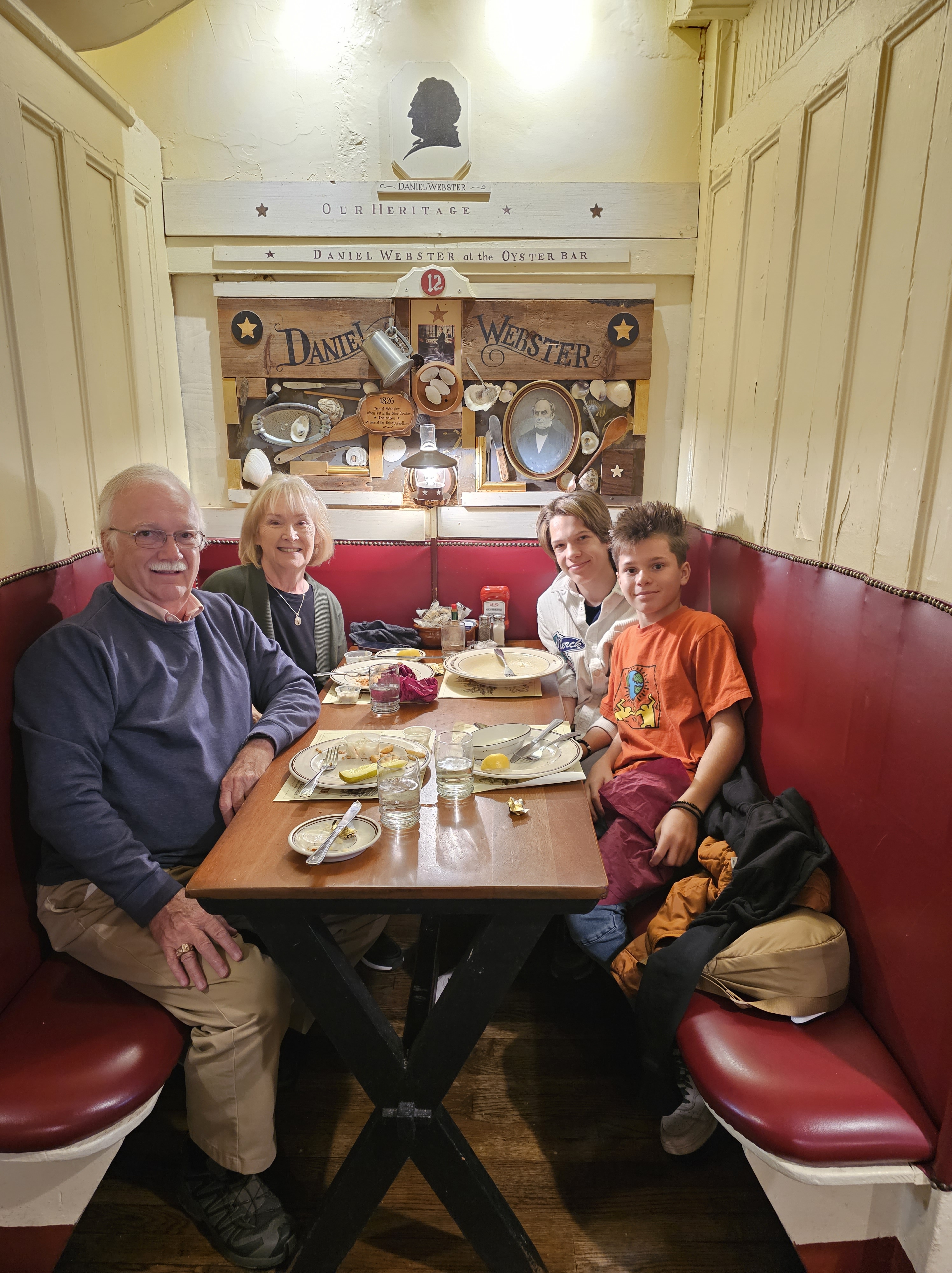
Boston at Thanksgiving 2023

We went with Leon and Julian to Boston for several days around Thanksgiving to explore history and see family. They were great travelling companions. The history included Plymouth, Lexington, Concord and the Freedom Trail in Boston. Julian is into robotics and was interested in MIT, so we spent a day there exploring the MIT Museum, Doc Edgerton’s Strobe Alley and the student activity, living and athletic facilities, joined by John’s roommate (1967-1969) Jesse and his wife Bonnie. We saw John’s nephew Scott and his sons Ryan and Alex at Dave & Busters and joined Paula’s family at Dan and Tina’s house in Shrewsbury for Thanksgiving dinner.

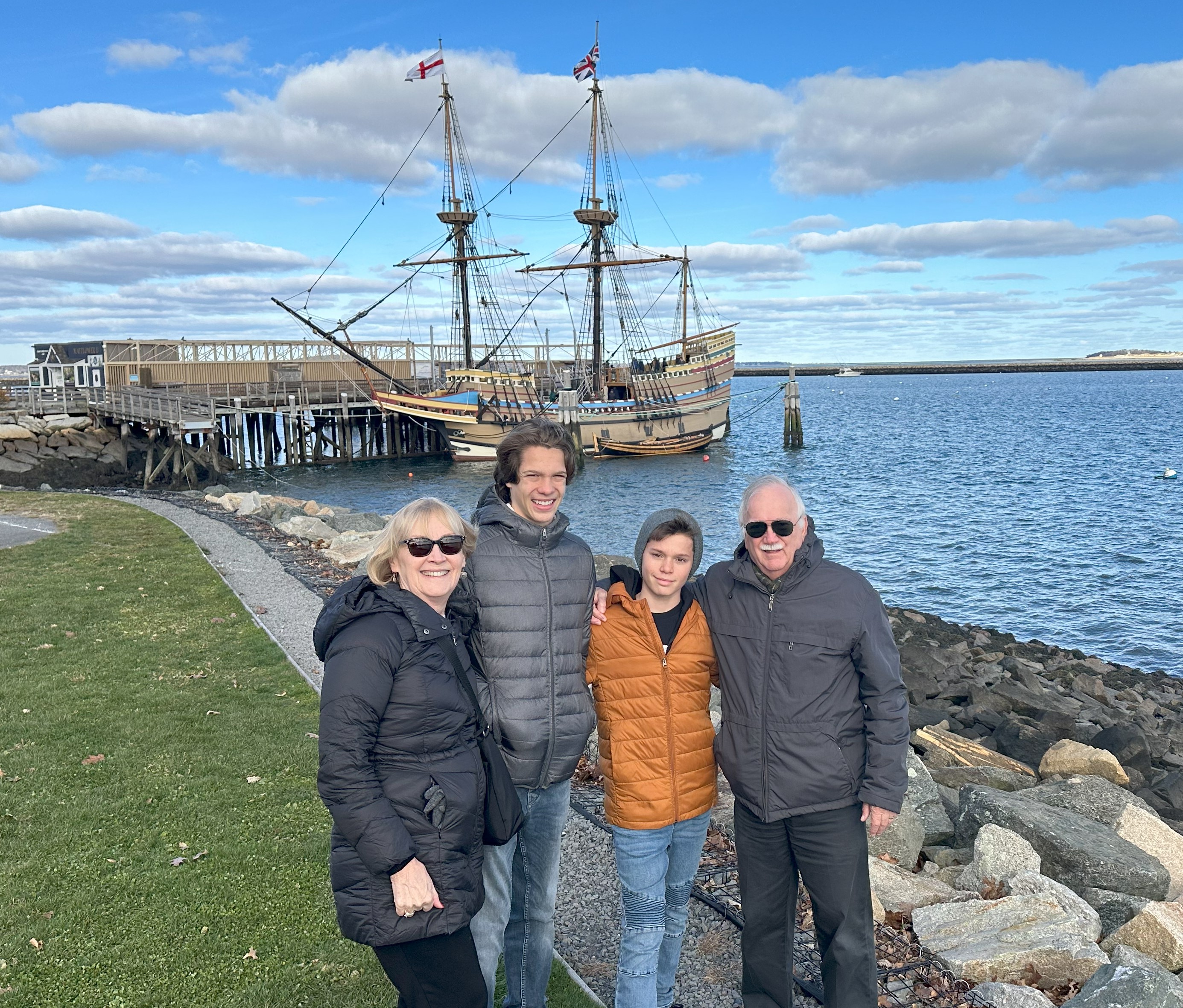
At Plymouth, site of the first Thanksgiving in 1621, with Mayflower II in the background
Visiting MIT with Jesse and Bonnie

Click on any image below to view a slideshow of full-size images.